Today, we are awarding a $50K First Letters Prize to Erwin Nieuwlaar for his work on PHerc. 343 (Biblioteca Nazionale di Napoli). He found the first ever text to be read in this carbonised, still-rolled scroll since it was buried in AD 79. Congratulations, Erwin!
After the research team of the Vesuvius Challenge fully virtually unwrapped PHerc. 1667 and revealed its ink back in June, and after ink was found in PHerc. 1447, things have been getting exciting: we are seeing growing momentum in the community to identify ink in more and more papyri.
This submission from Erwin was the first to meet our strict technical and papyrological criteria (10 readable letters in 4cm²). He made a short video about it too!
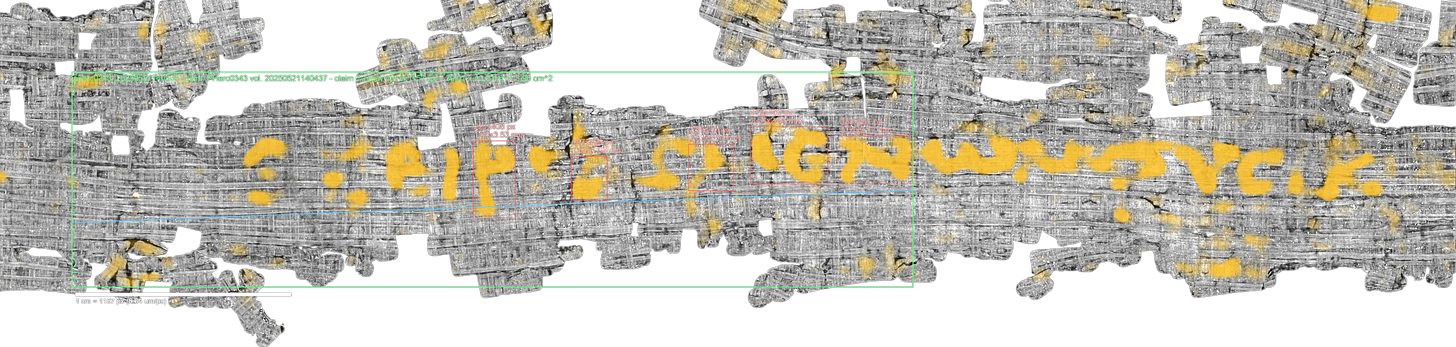
This is the image produced by his unwrapping and ink detection pipeline, with our papyrologists’ reading of the letters superimposed on the bottom version in green:
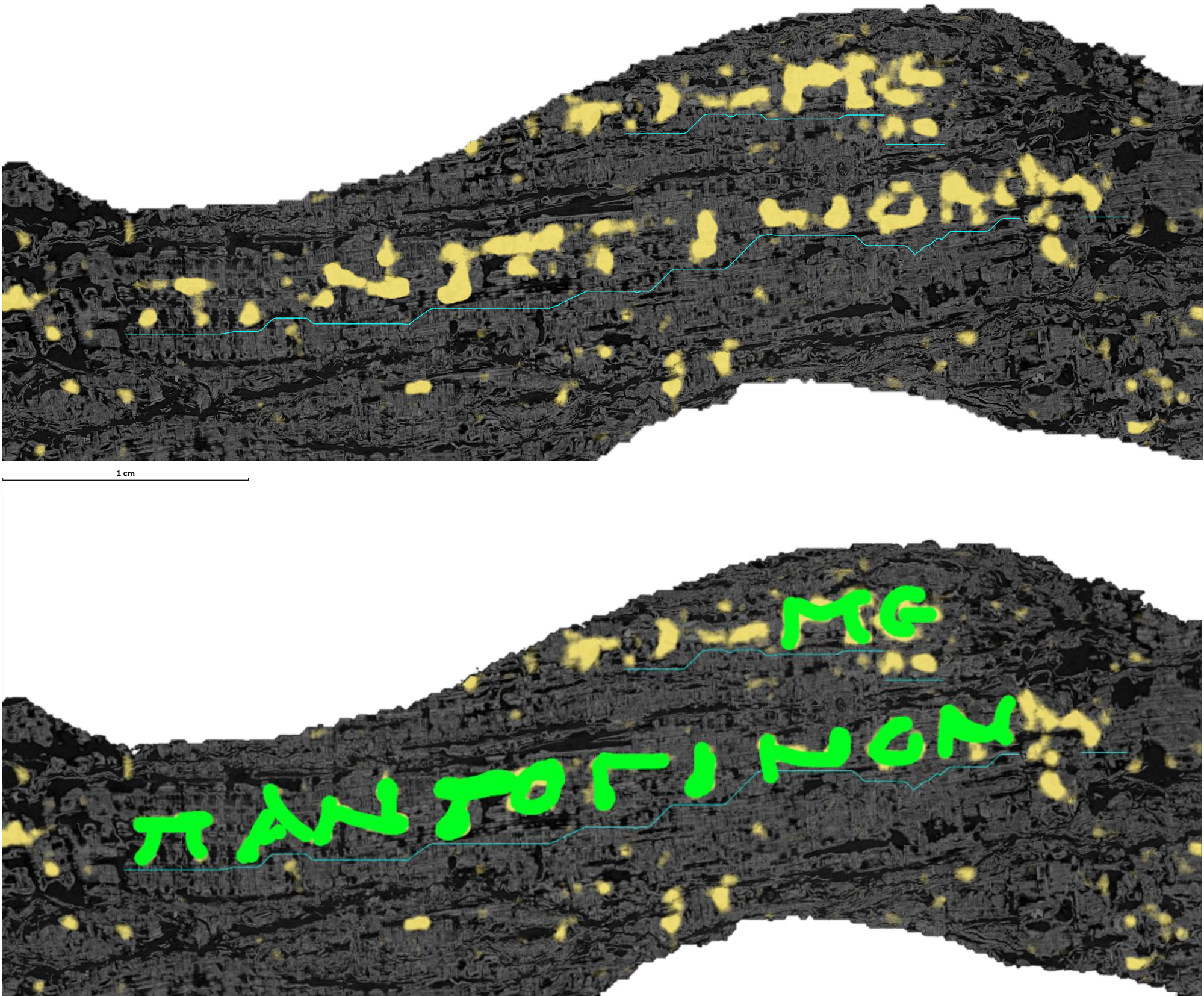
The submitted segment includes portions of four lines, with the third being the most legible. On its own, this line meets the 10-character target, offering a promising Greek sequence: πα̣ντ̣ογιν̣ομ̣, followed by a noisier character. According to most of our papyrologists, the sequence should belong to the expression πᾶ̣ν τ̣ὸ γιν̣όμ̣ε̣[νον, “everything that happens/is generated”.
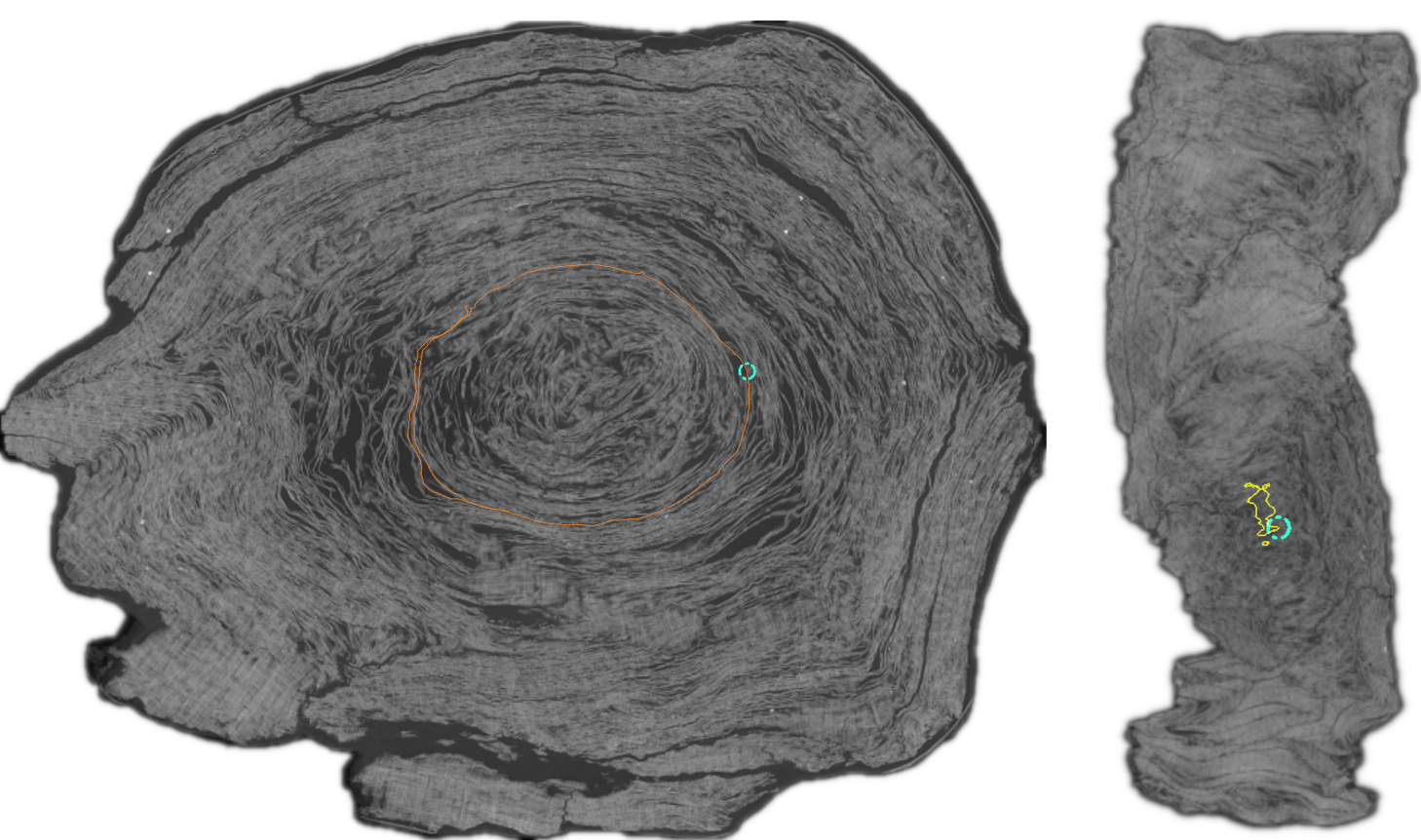
The following images show where this text was found, deep inside a cross-section of PHerc. 343 (the segment is the fine orange / yellow line):
Subscribe for free to receive more posts about our discoveries in the Herculaneum Papyri.
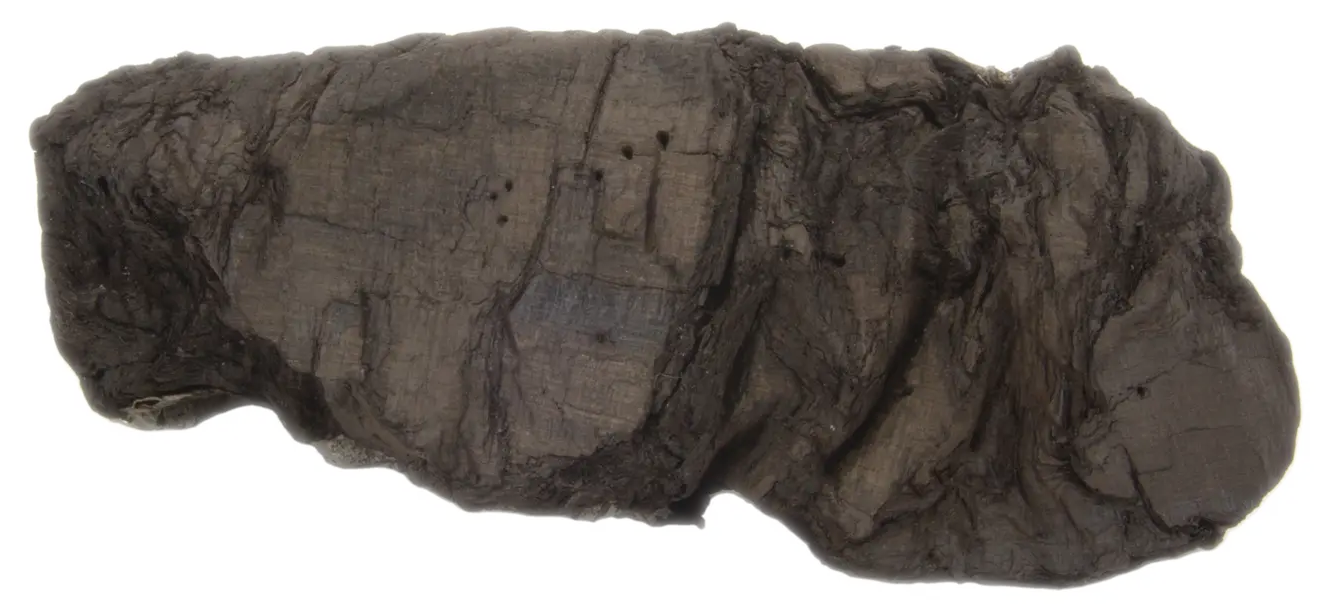
Here’s a photo of the carbonised scroll itself — it’s about 14cm long overall:
How it was done
Erwin traced the surface using the Vesuvius Challenge’s open-source spiral-fitter (developed by Paul Henderson & Sean Johnson), which Erwin adapted to run on the 8.64 µm scan of PHerc. 343, with his own estimate of the scroll axis (umbilicus). He also developed a new way to snap the segments more accurately to the papyrus surface. The letters lie on windings w047 and w048; the two original winding meshes were joined across θ = 0 into one segment.
Erwin ran four existing 9 µm ink models on PHerc. 343 and took their average: ink_9um (seeds 42 and 43, originally trained by Elian Rafael), Hecate (created by Giorgio Angelotti), and dense_native, his own fine-tune on PHerc. 0139. None of them were trained on PHerc. 343 itself – the models are generalising across scrolls. The main image shows the average of the four models, in yellow over a dimmed CT so the fibres stay visible.
Take a look at the video Erwin made for his friends and family after learning that he had won the prize, in which he explains his achievement.
A key tenet of the Vesuvius Challenge is that it is an open science project. You can reproduce Erwin’s results by following the instructions here – and maybe discover some other text that’s not been read for 2000 years.
About the winner
In his own words…
I am Erwin Nieuwlaar from the Netherlands, a freelance software engineer. Lately I have been working for the Netherlands Chamber of Commerce on digital identity, especially the European Business Wallet. When I came across the Vesuvius Challenge I found it fascinating, but at first it felt impossible to contribute anything significant. Because of this I started small by fixing bugs. That led to my first prize in July, which gave me a huge boost in confidence. After that first win, I booked a trip to Naples to see the scrolls, then learned they are shown only by appointment at the Officina dei Papiri. I emailed them, and the people at the Officina were so kind to make an exception and gave me and my lovely girlfriend Lotte a tour at their office. Once standing in that room I was VERY excited, and I left determined to keep working on these scrolls. Back home I bought a second hand RTX 3090 and rented GPUs for the bigger runs (about 300 dollars spent on rent uptil now). After a while I found some texture which was oddly well structured/sized, after in depth research on this particular place I found some first letters, which was truly amazing (I remember shouting at my screen “DIT IS TOCH GEWOON INKT” > “THIS IS SURELY JUST INK”). Many thanks to the Vesuvius Challenge. I really love the challenge, for me it is not a hobby but an obsession. Furthermore, I really like the Discord channel it is a very nice, welcoming and useful place (even though I dont write much there myself, I do read everything).
Not just one submission…
Several other submissions came our way after Erwin’s, which we would like to acknowledge as well, since they offer some interesting sequences from PHerc. 343.
Gabriel Munoz Mendonca’s submission did not reach the 10-character target, but offers some sequences of Greek text. In addition to the sequence θεν, which cannot be securely interpreted without a context, reads the sequence μ̣ουϲ̣. This, too, could be associated with different words and could represent either the beginning or the end of a word.
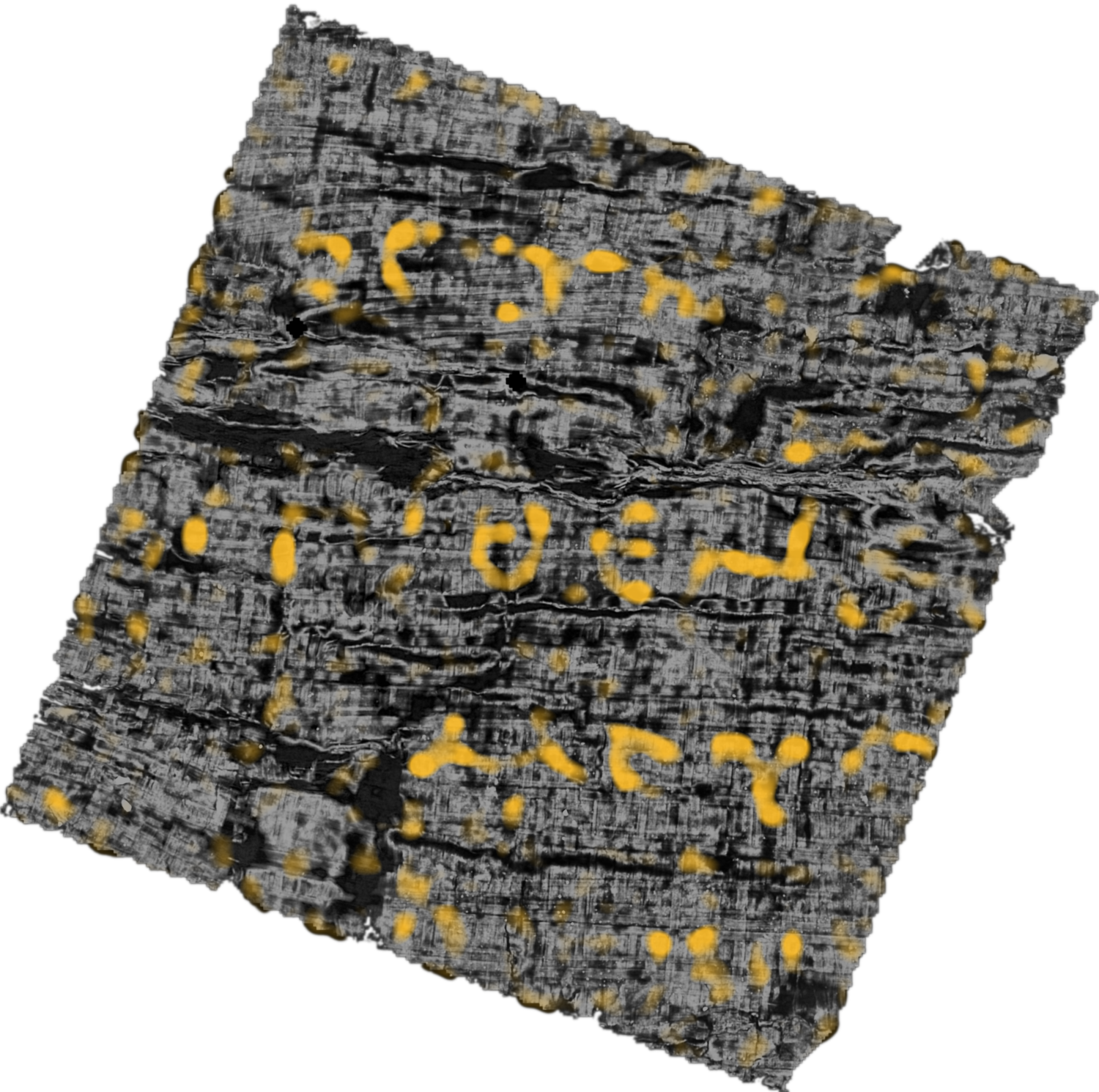
This is where the third submission from Ben Kyles and colleagues comes into play. They generated segments from a different area of PHerc. 343 with their ScrollFiesta! unwrapping pipeline. Ink detection again revealed readable text. After a sequence pointing to a participle of the verb ἐξεργάζομαι, “bring to completion”, “accomplish” (ἐξ̣ειργ̣α̣ϲμ̣ένῳ), the letters μουϲικ are quite clear, suggesting a reference to the semantic field of music. Could the μουϲ sequence in the segment mentioned above belong to a similar word?
Philodemus wrote a treatise On Music (PHerc. 1497), and music is referred to more than once in PHerc. Paris. 4. But to learn more about the potential presence of music in PHerc. 343, we need to read more!
The hunt for the Grand Prize is on!