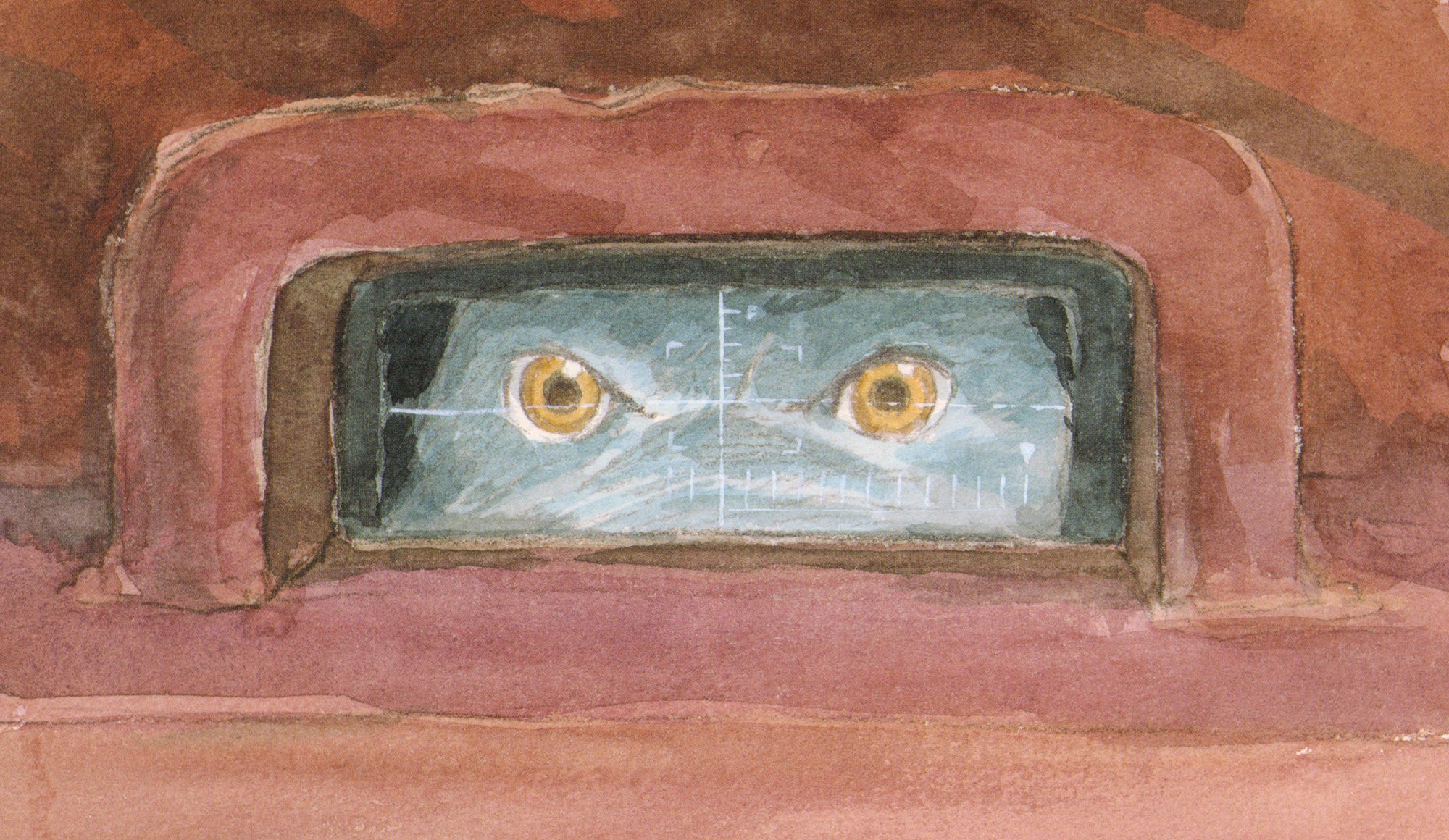
A Hayao Miyazaki concept sketch for Rowlf, courtesy of the book Nausicaä Prehistory
Welcome! It’s a new Sunday edition of the Animation Obsessive newsletter. Here’s the agenda for today:
- 1. Rowlf and Miyazaki’s turnaround.
- 2. Animation newsbits.
- 3. The last word.
With that, let’s go!
1. Transforming
In 1980, Hayao Miyazaki turned 39 years old. He was just shy of middle age, but he’d made almost none of the work associated with his name today.
He felt kind of washed up. Miyazaki’s debut feature The Castle of Cagliostro (1979) had flopped at the box office, and he viewed it as a rehash of his past projects. “I don’t think I added anything new,” he admitted. He saw his creations as stuck.1
“With every piece I made it was obvious that I was just trotting out everything I had done before [laughs],” he said. “Nineteen eighty was my year of being mired in gloom.”
He’d built a style and a set of reference points. Miyazaki excelled at children’s cartoons with big emotions, zany action, slapstick, good guys and bad guys. Among his influences were The Shepherdess and the Chimney Sweep and the Soviet Snow Queen from the ‘50s, and Fleischer stuff like Popeye and Mr. Bug Goes to Town.
But he started to believe that his approach was too simplistic. “I wondered if it was no longer possible to make an action movie where defeating the villain was enough to make a happy ending,” he said. The times had changed: heroism and villainy seemed like murkier concepts than they once were.2
As Miyazaki searched for other possibilities, he got into alt comics in the orbit of Métal Hurlant, a foreign magazine. That included Arzach by Mœbius. “I first saw it around 1980. It had a great impact on me,” he said.3 Meanwhile, an American comic from the same circle lit up his imagination. It was called Rowlf (1971).
“I chanced upon Rowlf around the time I was wondering what to do for my next work after I had completed Lupin the Third: The Castle of Cagliostro,” he wrote recently. He was so impressed that he proposed, in 1980, to adapt the story as his second feature film. That decision would change his career.4
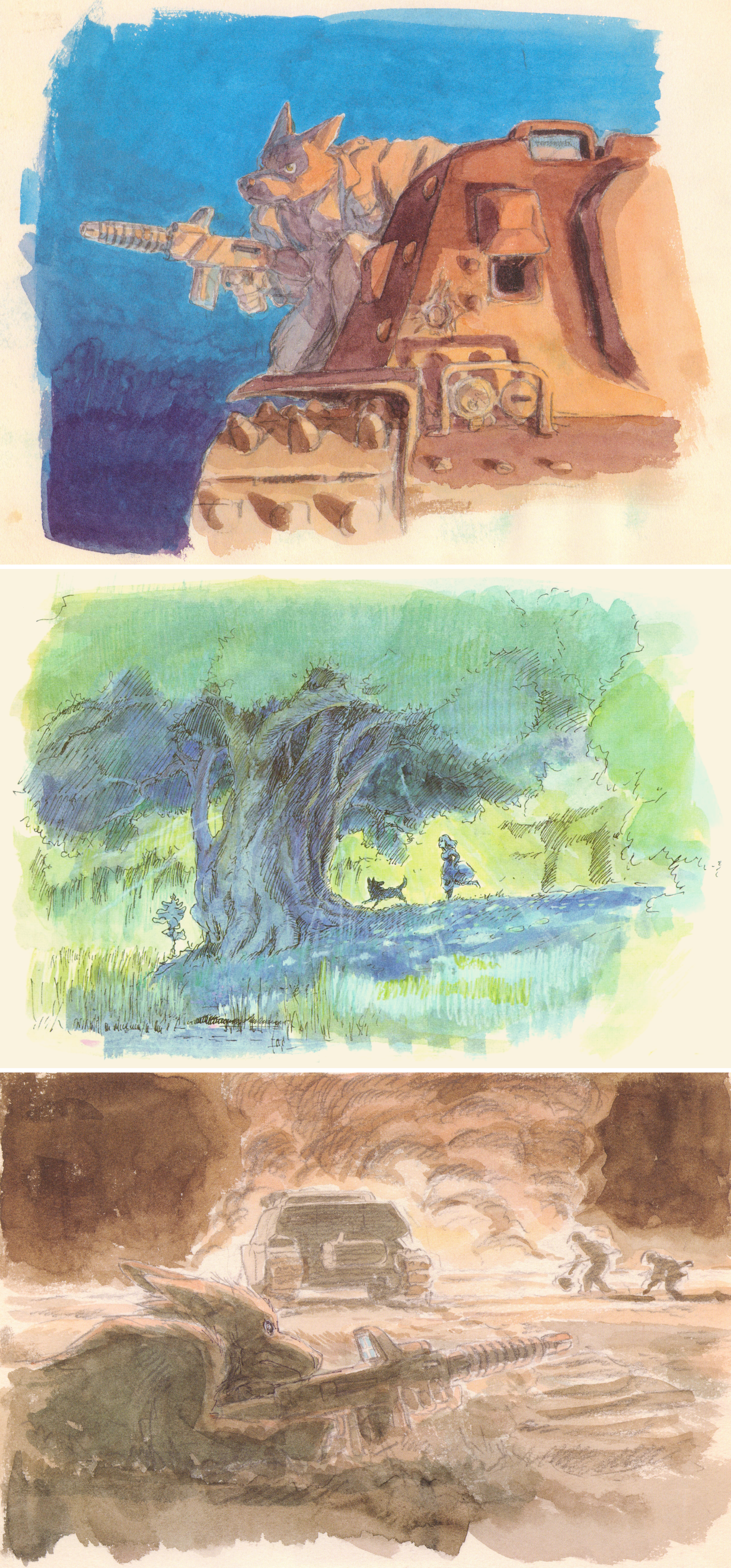
Hayao Miyazaki concept sketches for Rowlf, courtesy of the books Nausicaä Prehistory and Nausicaä of the Valley of the Wind: Watercolor Impressions
In many ways, Rowlf was the opposite of Miyazaki’s past loves. Author Richard Corben came from America’s underground comix scene. In their content, his violent, transgressive stories weren’t far off the exploitation films of their era.
Miyazaki wrote in 1980 that Rowlf “definitely is not for little children.” But he detected potential here:
In Rowlf, a world that appears at first to be grotesque and ironic is actually filled with faith in a healthy life. The story possesses the power of old fairy tales — the ability to encourage people, to reassure us and give us hope. It’s no exaggeration to say that it is rare to see such a work today.
Rowlf unfolds in a mixed-up world. In Corben’s description, “We have fantasy elements like the castles and medieval costumes and sorcerers, and then they clash with these mutants with their sort of ‘Panzer’ tanks.” He thought it up in the ‘60s as a film (he was an amateur animator) before he retooled it as a comic.5
Corben took from his childhood dog for the Rowlf character — the pet of Maryara, a princess. When she’s kidnapped, Rowlf turns into a kind of werewolf and goes on a rampage to save her. The narrative is basic, and its handling of its damsel in distress is flat and often in poor taste. But Corben had a knack for telling stories in images: Rowlf’s panels have a fleshy physicality and strong feeling of space. The Academy of Comic Book Arts named him the year’s top new talent.6
This edgy, 20th-century Beauty and the Beast story appealed to Miyazaki. Among its other qualities, he noted its “[d]ramatic staging, including the desert (upon which Rowlf’s tank casts long shadows).” But he found it “boring” to use Maryara as she was: “I wanted her to be more active in the story’s progression.”
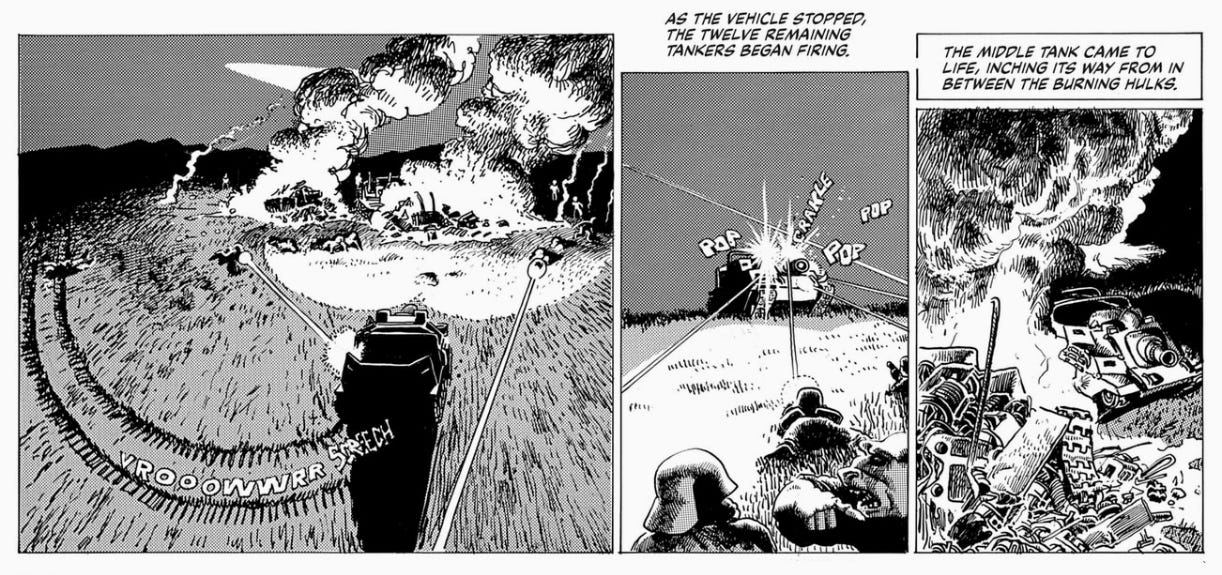
A few panels from Richard Corben’s Rowlf comic
In the concept sketches that Miyazaki and the artist Yoshifumi Kondo did for Rowlf, Maryara appears as a bolder character, sometimes holding weapons — one author mentioned the “nobility and inner strength” in these drawings. Along the way, Miyazaki added flying machines and other oddities from Mœbius.7
Although he was changing Rowlf, Miyazaki wasn’t turning it into the same type of story he’d done before. As the project evolved, he was evolving, too. Like he said:
While I was filling out Rowlf in this fashion, I moved further and further away from the original story. And as [Maryara] began to have a stronger mind and feelings, I ended up with “a princess in her castle” and “a pathetic father.”
This father was a little touched — while he had once been quite heroic, now he was confined to bed and completely useless. Yet despite this, he remained a very proud man. I believed a girl with that father would make Rowlf into a much more interesting story. Suitors came one after the other, their eyes on the country’s minimal wealth. … I was trying to build in a secondary theme in which she preserved her pride while rebuffing these men. …
The concept of someone struggling to live up to … responsibility had been planted inside my mind for the first time. Before that, all the characters I’d considered were completely free.
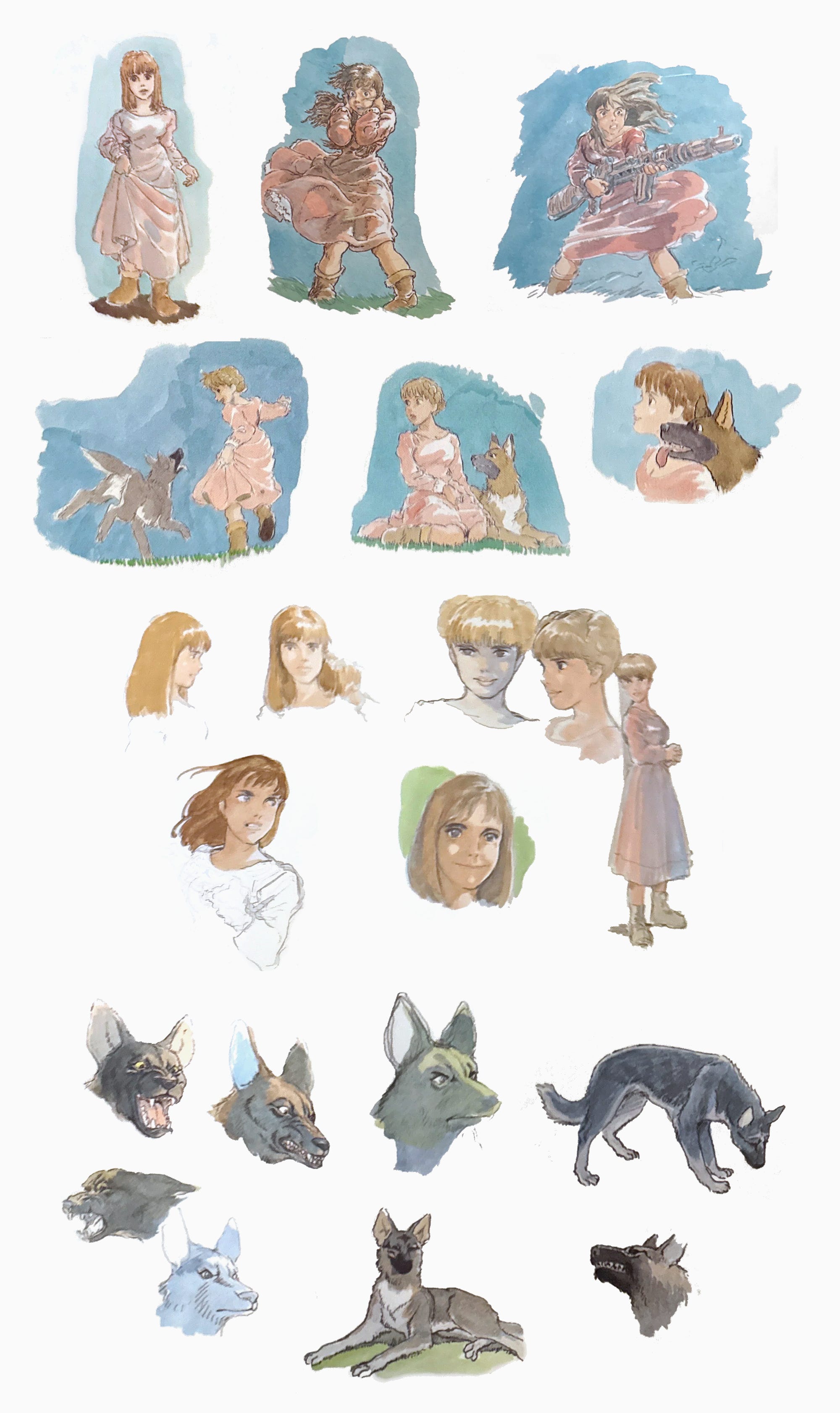
Concept sketches for Rowlf by Yoshifumi Kondo, as seen in Works of Yoshifumi Kondo
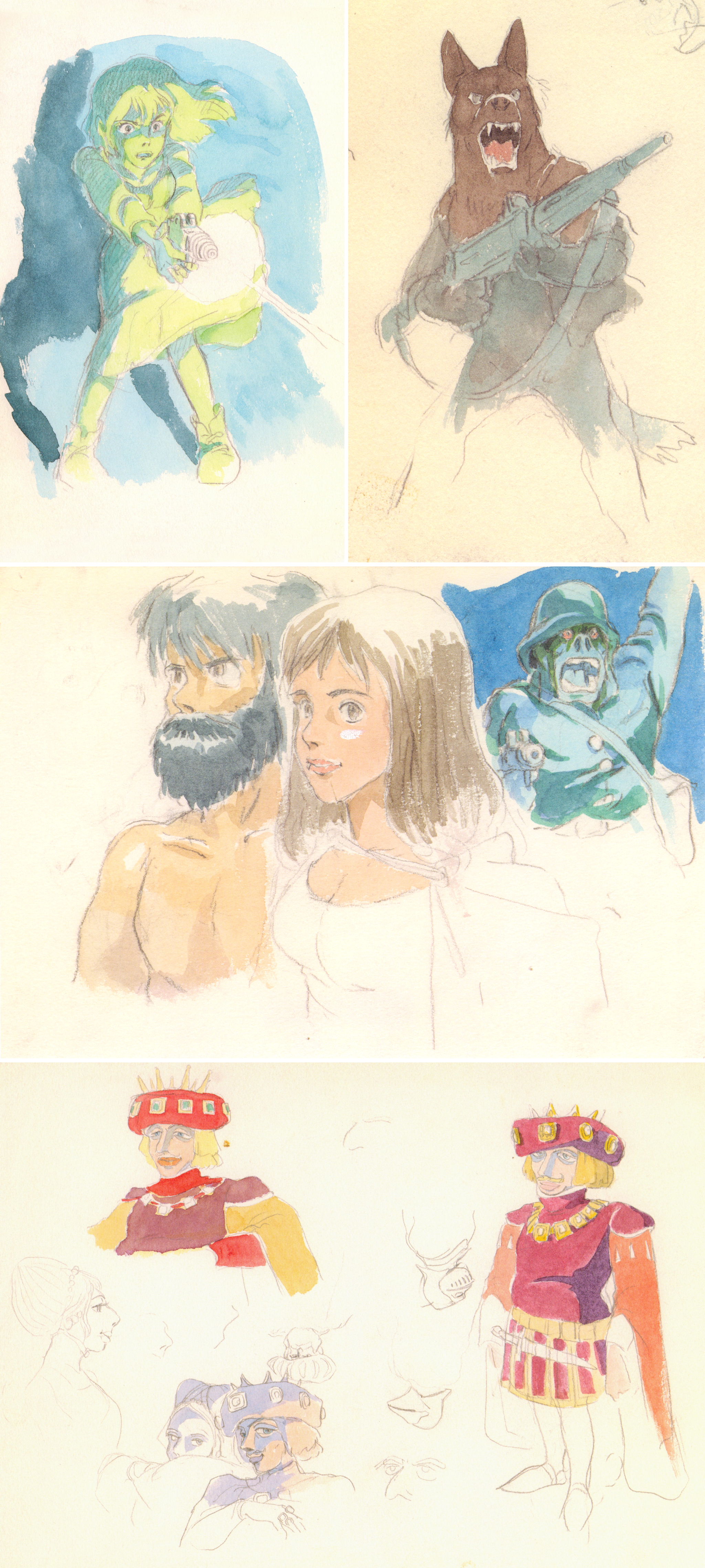
Miyazaki concept pieces for Rowlf — the last one appears to depict one of Maryara’s suitors. Courtesy of Nausicaä Prehistory.
When he first stumbled across Rowlf, Miyazaki was working with Tokyo’s Telecom (Cagliostro). The producer Yutaka Fujioka established the studio with one major goal: to cross over in the West.
According to animator Yasuo Otsuka, Fujioka had dreamed since the early ‘70s of blowing up in America — business meetings with Max Fleischer made him think it was possible. From there, Fujioka did lots of wheeling and dealing in Hollywood.8 And Rowlf was part of that effort. In late 1980, Miyazaki opened his proposal to the studio like this:
I think that Rowlf would be ideal for a theatrical feature film targeting the American market. … [I]f handled properly it could potentially appeal to all classes of young Americans and far surpass the appeal of Bakshi’s Wizards. The images in Rowlf may seem unfamiliar and grotesque to Japanese audiences, but by massaging them and making them more digestible, I believe the film could also attract young Japanese audiences.
Miyazaki’s reference to Wizards shows what he had in mind here. His Rowlf would retain that alternative energy he got from Mœbius and from Corben’s original comic. And it would go for older viewers than Miyazaki normally did. This project was a very different thing than, say, his Future Boy Conan (1978).
He wrapped up his proposal with these words:
Rowlf is unconditionally devoted to his mistress, Maryara, but audiences will be particularly inspired and impressed by his courage as he becomes more self-aware, starts to learn and eventually matures to the point where he can take on the demons.
For today’s young people — who feel over-managed, overprotected and suffocated by society, or who find their choices increasingly limited and thus are increasingly neurotic — this story would be the ideal present.
Fujioka was sold, and he wasn’t the only one. In 1981, Miyazaki told Osamu Tezuka about his intention to animate Rowlf. The author pledged his support for the project in Animage. “I’m certain that Miyazaki-san will make it into a fantastically amazing film,” he wrote.9
The hurdle was Corben. For a time, the “agents were going back and forth,” Miyazaki said. At one point, Fujioka went to cut a deal himself.
“Fujioka-san became interested in Richard Corben because of his popularity in America,” wrote Otsuka, “and he went to Cincinnati to meet Corben in person, but Corben turned him down because Miyazaki-san’s sketches were significantly different from his own drawings.”10
Having survived from 1980 until 1982, the Rowlf film was finally abandoned. “Richard Corben and the other Americans never really shared our enthusiasm,” Miyazaki recalled.
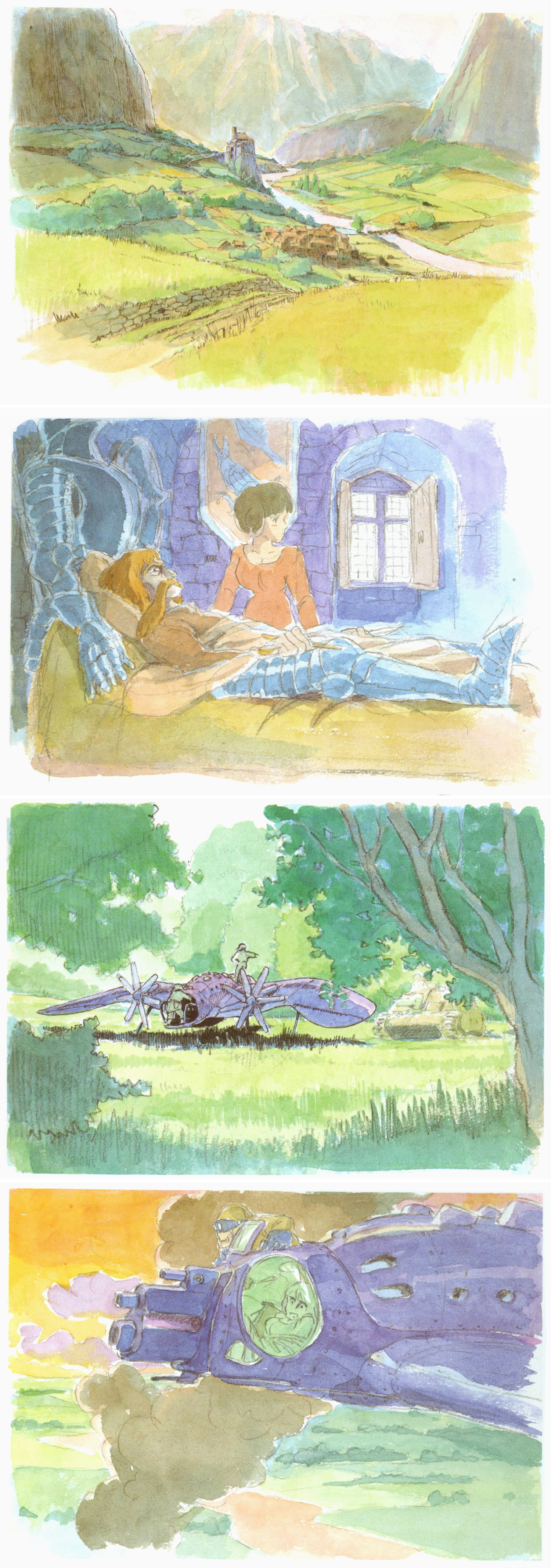
Miyazaki concept sketches for Rowlf, courtesy of Nausicaä of the Valley of the Wind: Watercolor Impressions
Later in the ‘80s, Miyazaki and Mœbius became friends and mutual fans. Corben, though, seemed to have zero curiosity about any of this stuff. In an interview before his death nearly 40 years later, he said, “I’m afraid I don’t know anything about Hayao Miyazaki or his work.”11
In retrospect, Miyazaki was generous about it all. “In those days I was a newcomer as a film director,” he wrote. He suspected that, to Corben, he was “some complete nobody from Japan coming up … and demanding the rights.”
Still, Miyazaki left Rowlf behind. Even when the chance to pursue an adaptation arose again, some years later, he didn’t go for it.
He didn’t need to go for it. The characters, setting and story he’d developed for the Rowlf film had stayed with him. His reworked Maryara transformed into Yara — the hang-gliding princess of a small science-fantasy kingdom, who was “standing firm under enormous pressure.” When Miyazaki made this idea into a manga series in 1982, he switched Yara’s name, for originality’s sake, to Nausicaä.
Miyazaki’s Nausicaä of the Valley of the Wind manga was the work of a changed artist. He’d internalized those alt comics: the fleshier and heavier and more grotesque drawings, the style of hatching, the darker and more adult stories. “I created Nausicaä with Mœbius’s influence,” he said later. But Corben was absolutely in there, too.
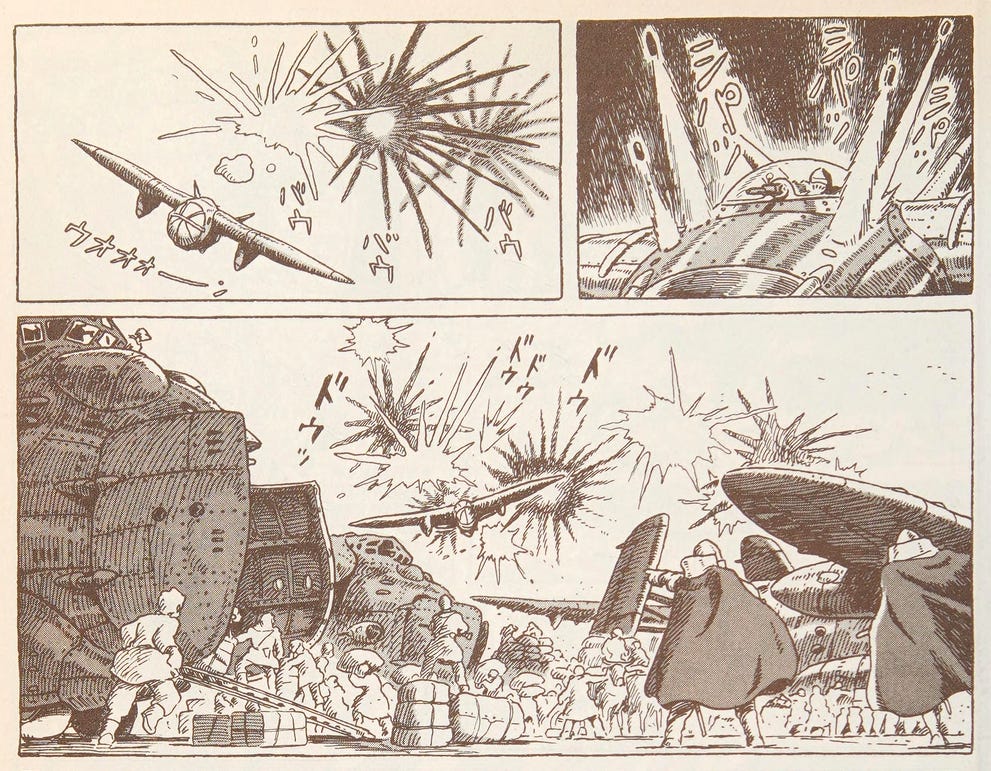
Panels from Nausicaä of the Valley of the Wind
In fact, Miyazaki’s theme from Rowlf finally got used in Nausicaä. He wrote that the series was meant to “offer a sense of liberation to present-day young people who, in this suffocating, overprotective and managed society, find their path to self-reliant independence blocked and have become neurotic.”12
Soon, his 1984 film adaptation of his own Nausicaä manga turned him into an icon among Japan’s animation fans. The cartoony action that’d been Miyazaki’s calling card vanished here, as did the type of “very simple story” he’d used for Sherlock Hound and Cagliostro, with their bad guys and straightforward happy endings.13 In every part of Nausicaä, there was a fresh weightiness.
Miyazaki owed the new version of himself to ideas from outside — to those alt comics, and to the films of Yuri Norstein and Frédéric Back, which he discovered around the same time. His willingness to learn from them gave his work a new layer that it never lost. Now, in his 40s, he’d reached the second start of his career.
2. Newsbits
- In India, Studio Eeksaurus released The Godawan (watch) — one of the most impressive achievements in stop motion we’ve seen from the 2020s, and more evidence that Eeksaurus stands with the best animation teams working today.
- In America, the indie animated features Shine (Baobab Studios) and The Long Walk (Namethemachine) received millions in tax credits from California.
- Also in America, Cartoon Network was reportedly hit by a “gigaleak.” Decades’ worth of production materials are floating around on social media.
- In our first newsbit from Vatican City, Pope Leo XIV has been issuing criticism of GenAI art. “There is an ontological difference, even before an aesthetic one,” he argued, “between art and what a machine can generate through statistical calculation based on millions of images created by others.”
- After its Annecy awards this summer, the Ethiopian series Sunday Morning is looking for further support at Durban FilmMart.
- The Lucas Museum of Narrative Art is screening a number of classic films by Norman McLaren, Evelyn Lambart and others from Canada’s NFB.
- In Serbia, the digital artist Neon Noodle spent over a year colorizing the Fleischer cartoon Bimbo’s Initiation (1931). They tell us, “No AI was used; every frame was colored manually in Photoshop.” It’s an interesting project — find it on YouTube.
- Britain’s Nick Park has a new book, Grand: The Autobiography of Gromit, coming out later this month.
- The Canadian film Nenaboozhoo, based on a traditional story and narrated in the Ojibwe language (with English subtitles), is now on YouTube.
- A composer in France, Yanni Ziangos, created music for a cartoon-inspired game called Dodo Duckie. “When I compose for animated scenes, I try not to chase every movement,” he told us, “If a gesture or visual gag needs a precise musical accent, I’ll give it one, sometimes two; elsewhere, I let the orchestral phrase continue so the scene can breathe.”
- Meanwhile, in Czechia, the talented animators (and painters and more) of Amanita Design are making Machinarium 2.
- Finally, we wrote about Robert Cannon, What’s Opera, Doc? and video assist.
3. Last word
That’s today’s issue! Thanks for reading. We’re closing out with personal comments from the two of us:
Jules: One of my favorite things to study and think about is the never-ending dialogue that occurs between artists, across the world and across time. While creating Star Wars, it seems plain that George Lucas borrowed ideas and visuals from the Franco-Belgian comic Valérian and Laureline. The huge success of Star Wars is often credited with starting a sci-fi fad (around the globe and in Japan), which boosted the popularity of the Space Battleship Yamato movie, released just a few months later in ‘77. The success of Yamato, in turn, helped to spark an anime goldrush that saw many more movies funded — one of which was Miyazaki’s own Franco-Belgian-comic-inspired Nausicaä. And that’s not getting into the influence Nausicaä itself had! All this just from following a single, small thread of exchange.
John: I’m a believer in state support for the arts. It’s not perfect and (in certain times and places) it’s been a bureaucratic nightmare — but I can’t tell you how many artists it’s helped in animation. Even in the 2020s, it’s allowed great films like Flow*,* Robot Dreams and the new Knowing Gaze to exist. So, I’m very excited that a couple of indie animated features just received tax credits from California. The animation world often has to fend for itself in America, no matter how many times government investment in stuff like Sesame Street pays off. I hope that’s finally changing. Fingers crossed.
Until next time!
From Starting Point 1979–1996 (“Miyazaki on His Own Works”), also the source of the following quote.
See Nausicaä of the Valley of the Wind: Watercolor Impressions, one of our two main sources today.
From this video about Miyazaki and Mœbius, used a couple of times.
The quote comes from Miyazaki’s introduction to Rowlf and Other Fantasy Stories, used a couple of times. For the 1980 detail, see Starting Point 1979–1996 (“A Proposal to Acquire Film Rights”), our other main source.
See the interviews with Corben in Voice of Comicdom (Winter 1970) and Comic Book Rebels.
For the award, see Cartoonist Profiles (September 1972).
See Seiji Kanoh’s site for the credit on Rowlf’s image boards and the duration of the project. The quote comes from the book Works of Yoshifumi Kondo (近藤喜文の仕事).
See Drawings Covered in Sweat: Latest Revised Edition, starting on page 272.
From Animage (August 1981), page 52.
From The Aspirations of Little Nemo (リトル・ニモの野望), page 112.
For Miyazaki’s friendship with Mœbius, see the archived interviews here and here. Corben’s quote comes from an interview that ran in Heavy Metal #301 (November 2020).
See Starting Point (“A Film That Can Be Enjoyed by People Who Have Never Read the Original Story”).
Miyazaki made this point in Starting Point (“Nature Is Both Generous, and Ferocious”).