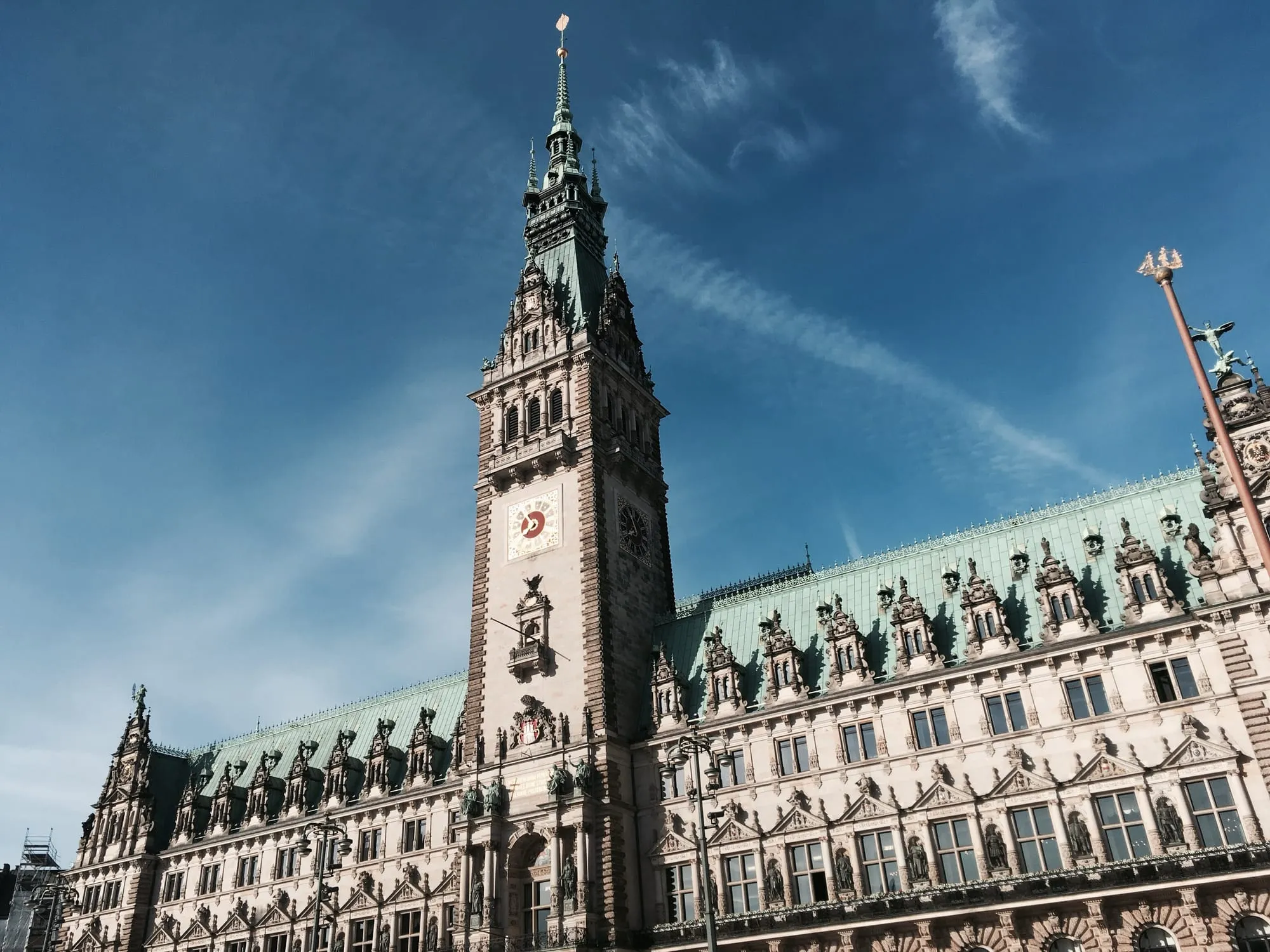
The Rathaus was one of the first things I photographed in Hamburg. The picture is still in my camera roll, taken on 6 July 2017, five days after I arrived for an internship. Like most visitors, I was impressed by its size and its tower, but what I kept coming back to was the roof. Why was it turquoise, and why were so many other roofs in the city the same colour?
My first Rathaus picture
The answer turned out to be chemistry. The roof is copper, and copper slowly reacts with oxygen, water and carbon dioxide in the air. Over the decades this forms a green layer called patina, so the roof I was looking at wasn't the colour the builders had seen.
That was the first time the Rathaus made me curious, but not the last. On a city tour with Robin and the Tour Guides, our guide pointed out the emperors on the façade, the Phoenix and the Hanseatic coats of arms. We only heard a little about each, but it was enough to make me look at the building differently.
Later, I decided to build a digital 3D model of the Rathaus, which meant photographing it from every side. Zooming in, I kept finding faces, figures and coats of arms I had never noticed from the square. Reading about them one by one, I realised the Rathaus can be read like a book about Hamburg's history.
In this article, I'd like to take you around the building and share what I found.
A building that rose from the ashes
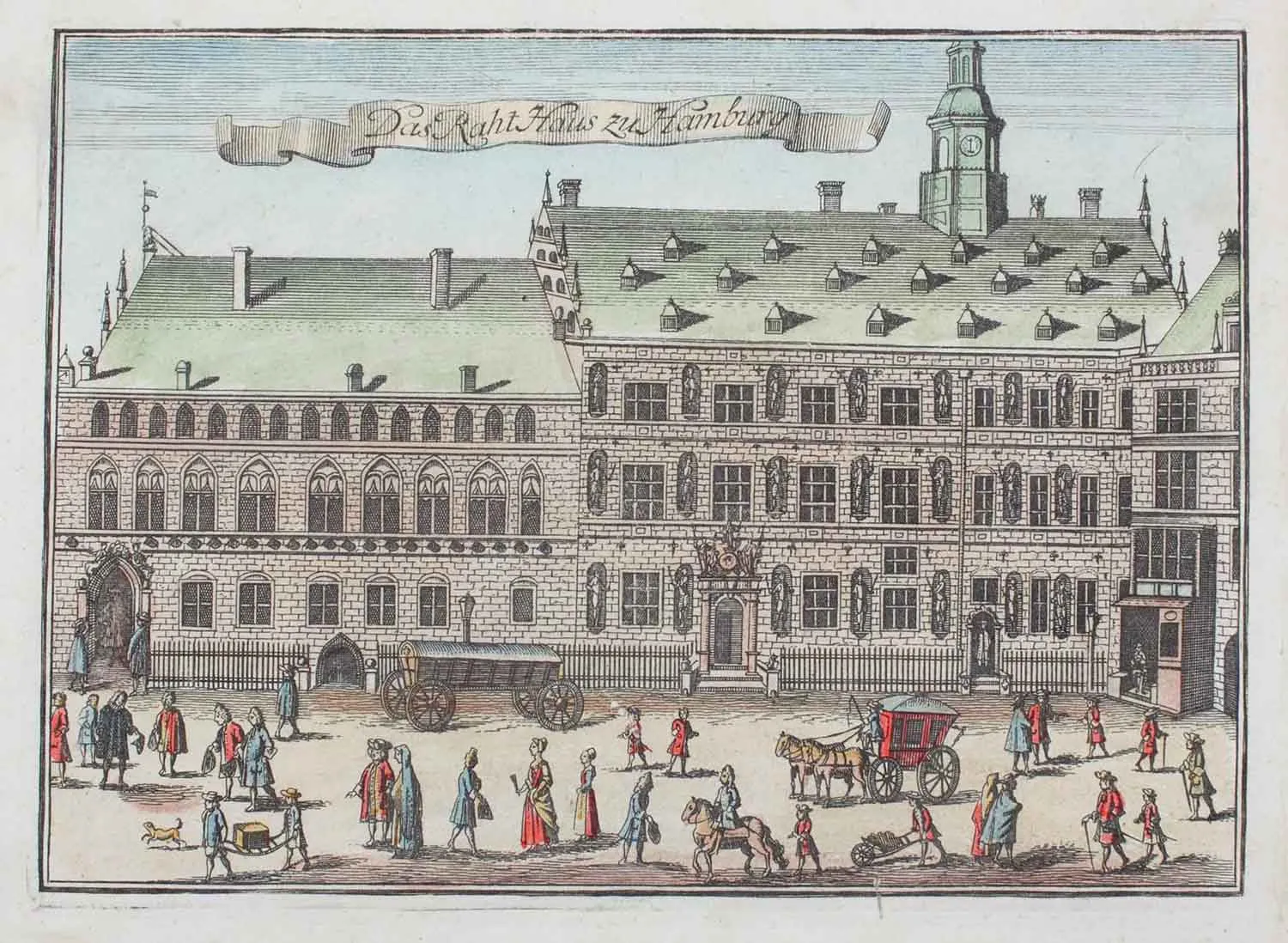
The Rathaus we see today isn't Hamburg's first. It's probably the sixth, and fire runs through the story of the ones before it. An early Rathaus, built after the old town and the new merchant town joined in 1216, was most likely lost in the city fire of 1284. Around 1290, a bigger brick Rathaus was built next to the Trostbrücke, and it stood there for more than 550 years.
The old Rathaus, 1700
Then, in the night of 5 May 1842, the Great Fire broke out. The flames spread quickly through the narrow streets, and on the morning of 6 May the people of Hamburg blew up their own Rathaus with 800 pounds of gunpowder, hoping to stop the fire. It didn't work, and the fire went on for days. Today the Haus der Patriotischen Gesellschaft stands where the old Rathaus once was.
It took 55 years until Hamburg had a new Rathaus. The foundation stone was laid on 6 May 1886, exactly 44 years after the old one was blown up, and the building opened in 1897. Its front is 111 metres wide, and its tower is 112 metres high, almost exactly as tall as the building is wide.
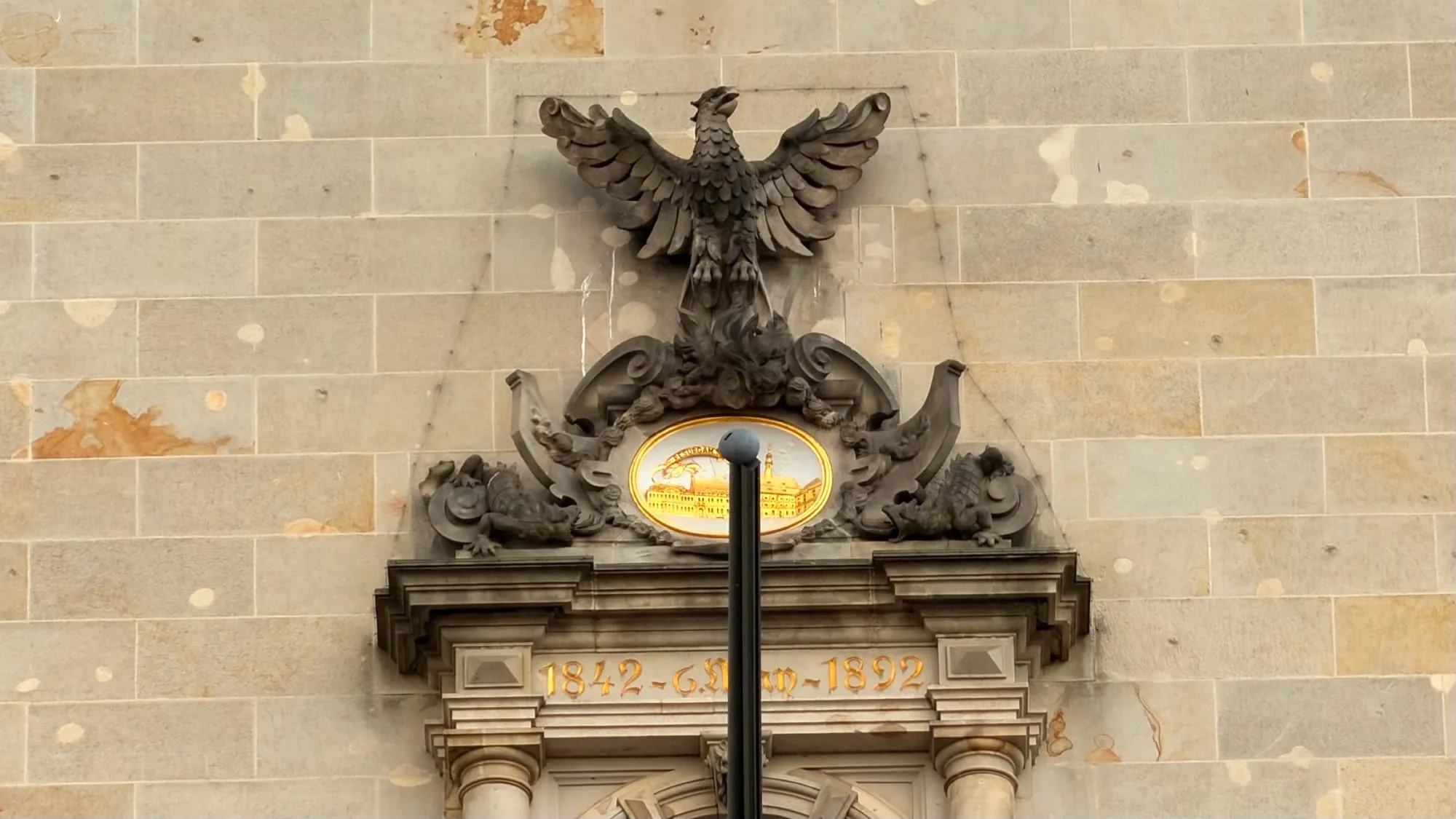
The fire is remembered right on its front. High on the tower, between the clock and Hamburg's coat of arms, sits a Phoenix, the bird that rises again from its own ashes, with wings more than 2 metres wide. Below it, a gilded medallion shows the old Rathaus and the word "Resurgam", meaning "I will rise again". In 1892, exactly 50 years after the fire, the Phoenix was pulled to the Rathaus by four black horses.
The Phoenix
In the summer of 1943, the bombing raids of Operation Gomorrah destroyed large parts of Hamburg. This time the Rathaus was spared. It was one of the few historic buildings in the centre to survive, and that's why we can still read every detail on its façade today.
The emperors on the façade
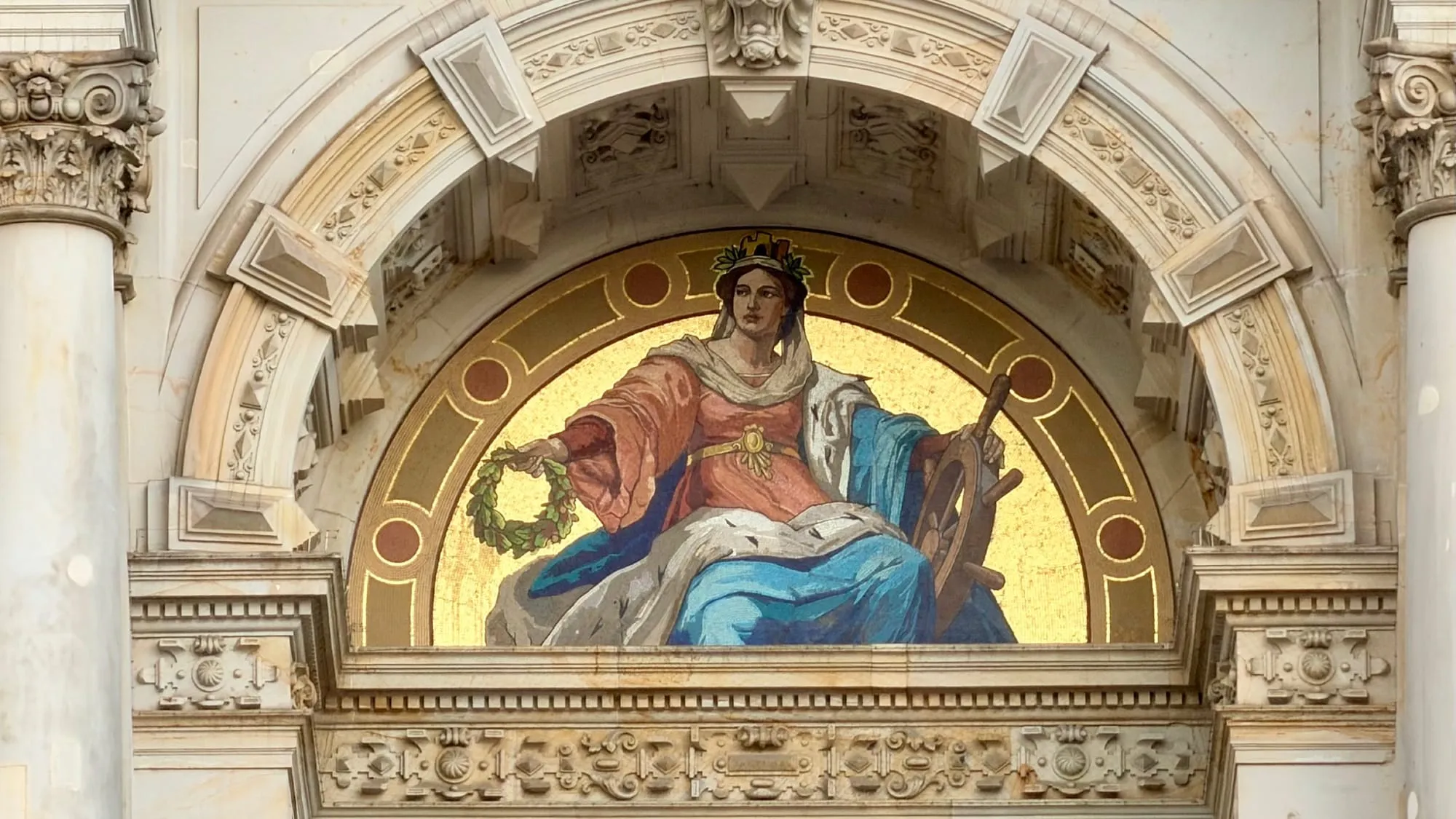
Above the main entrance, two emperors stand on either side of the balcony: Charlemagne on the left and Friedrich I Barbarossa on the right. Between them, in the background, Hammonia looks down from a golden mosaic made in 1896, holding out a wreath. She is the goddess who stands for Hamburg, much like Britannia does for Britain, and she represents the city's values: freedom, peace, trade and prosperity.
Hammonia
It might seem strange that a city so proud of its freedom puts emperors on its town hall. But Hamburg never had a king of its own. Over the centuries, the Dukes of Saxony, the Counts of Holstein and later the Kings of Denmark all claimed power over the city, and Hamburg's answer was always the same: it answered only to the emperor, the head of the Holy Roman Empire. When Denmark claimed Hamburg in 1618, the city added emperor statues to its old Rathaus to make that point, and the new Rathaus carries on the tradition.
Around them are a few more details. Above Charlemagne is a small coat of arms with a black eagle on gold, the eagle of the empire. Above Barbarossa are three black lions on gold, the arms of his family, the Staufer. And on the columns next to the statues are the letters SPQH, short for Senatus Populusque Hamburgensis, "the Senate and the People of Hamburg". It's a copy of the SPQR of ancient Rome, and a reminder that even standing next to the emperors, the city was run by its own citizens.
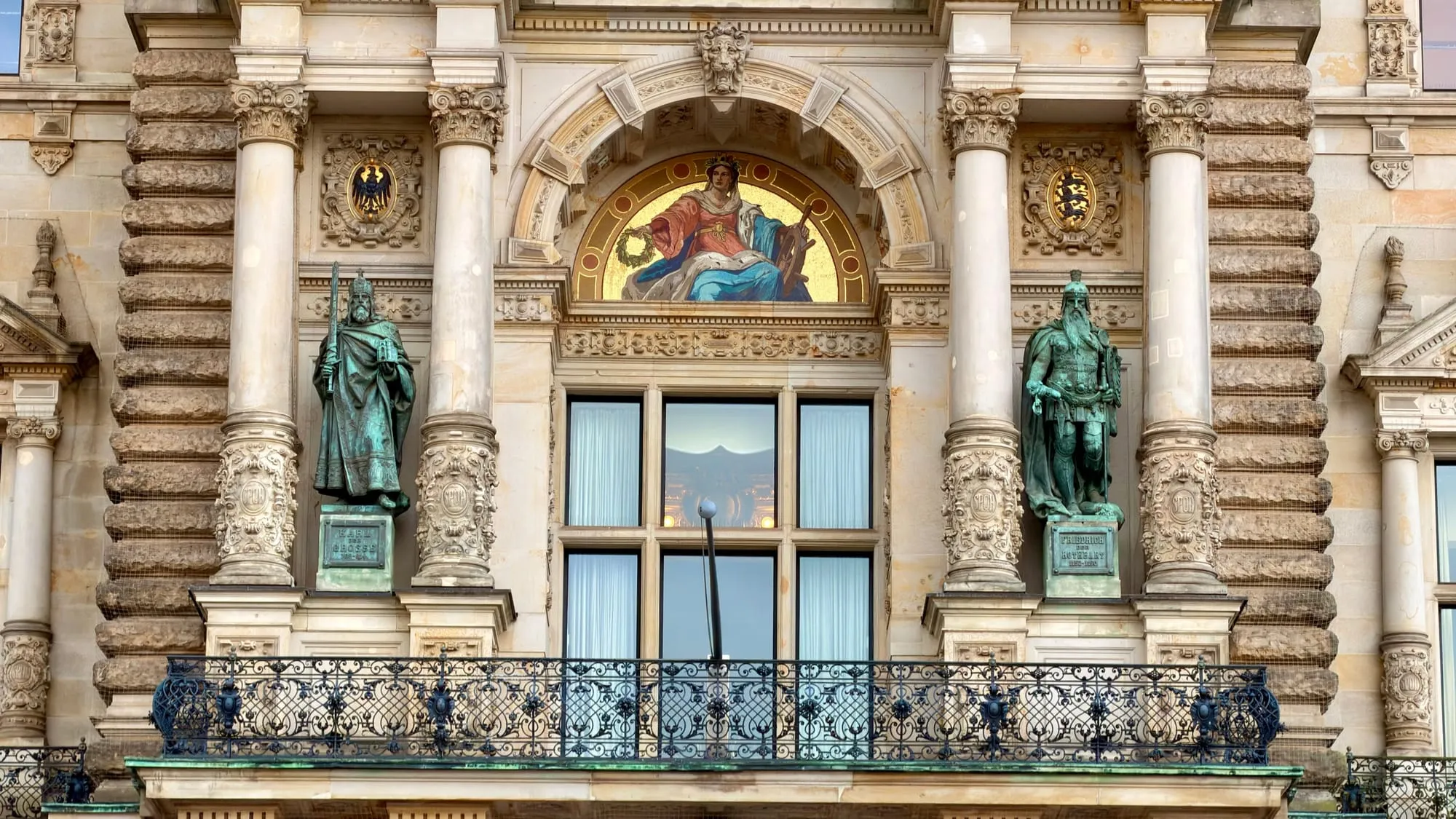
Charlemagne (left) and Barbarossa (right)
Charlemagne (768–814) is where Hamburg's story begins. He was crowned emperor in 800, and in his time the area around the Alster and the Elbe came under Frankish rule. According to old stories, he also started the first church here. So it makes sense that the whole line of emperors starts with him.
Barbarossa (1152–1190) is there for a very different reason. On 7 May 1189, he is said to have given Hamburg the right to sail down the Elbe to the North Sea without paying any tolls. This is seen as the birth of the port, and the city still celebrates it every May with the Hafengeburtstag, the harbour's birthday.
The twist is that the document is a fake. Count Adolf III, who ruled Hamburg at the time and joined Barbarossa on his crusade, most likely did get some kind of promise from him. But Barbarossa died on the crusade, and there was no written proof. Decades later, the people of Hamburg wrote the charter themselves, with everything they wanted in it, and got it sealed with the seal of Barbarossa's grandson, Friedrich II. Historians have known this since 1907, but the city celebrates anyway. I find it funny that one of the biggest ports in the world partly owes its start to a clever trick.
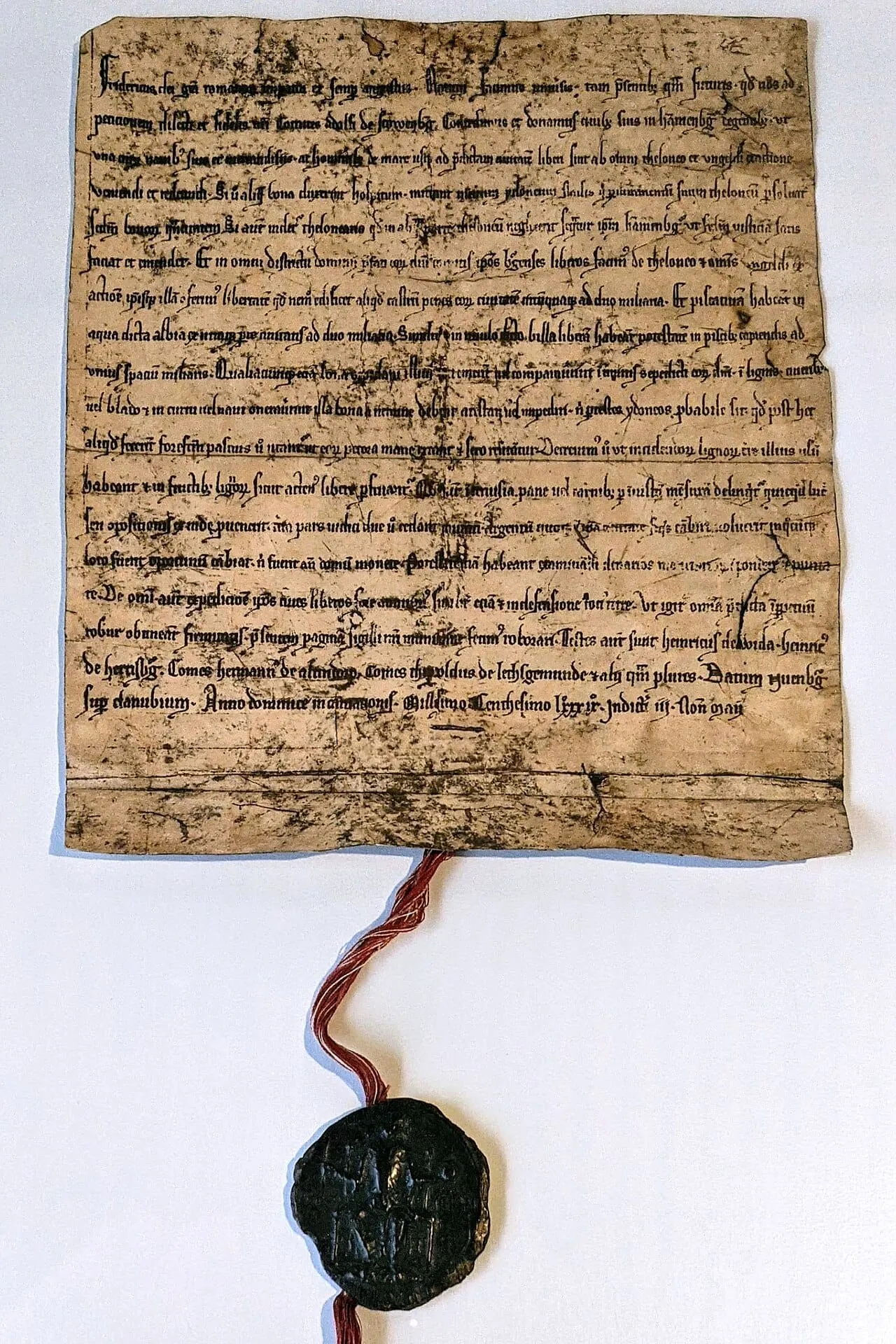
Hamburger Barbarossa-Freibrief 1189. Von Uwe Rohwedder - Eigenes Werk, CC BY-SA 4.0
The other 18 rulers stand in the niches between the first-floor windows, and Charlemagne and Barbarossa split them in time. Charlemagne leads the older rulers on the left, and from him the line moves forward in time until Lothar III, who died in 1137. Barbarossa, who became king 15 years later, leads the newer ones on the right, and from him the line continues all the way to Franz II, the last emperor, in 1806. Strictly speaking, not all of them belong to the Holy Roman Empire: the first five ruled before the empire began in 962, in the Frankish empire, but in the 1890s they were seen as the start of the same line.
When I was photographing them, I noticed that the emperors stand behind thin nets. At first they made them look a bit trapped, but I guess the nets are there to keep the pigeons away. These men once ruled large parts of Europe, and today they need protecting from the pigeons on the Rathausmarkt.
Left of the balcony, from Charlemagne outwards
- Ludwig the Pious (814–840): Charlemagne's son, who made Hamburg the seat of an archbishop around 831.
- Ludwig the German (843–876): Charlemagne's grandson and king of the eastern Franks, in whose time Vikings burned Hamburg in 845.
- Konrad I (911–918): Duke of Franconia, chosen as king after Charlemagne's family line died out in the east.
- Heinrich I (919–936): The first king from Saxony, the region Hamburg belonged to, who fought back the Danes in the north.
- Otto I, the Great (936–973): Heinrich I's son, whose crowning in Rome in 962 marks the start of the Holy Roman Empire.
- Otto II (973–983): Otto I's son, during whose last year a Slavic uprising reached Hamburg and burned the town.
- Konrad II (1024–1039): The first emperor of the Salian family, who added the Kingdom of Burgundy to the empire.
- Heinrich III (1039–1056): Konrad II's son, so powerful that he removed three rival popes in 1046.
- Lothar III (1125–1137): Duke of Saxony and later emperor, who gave the area around Hamburg to the Counts of Schauenburg.
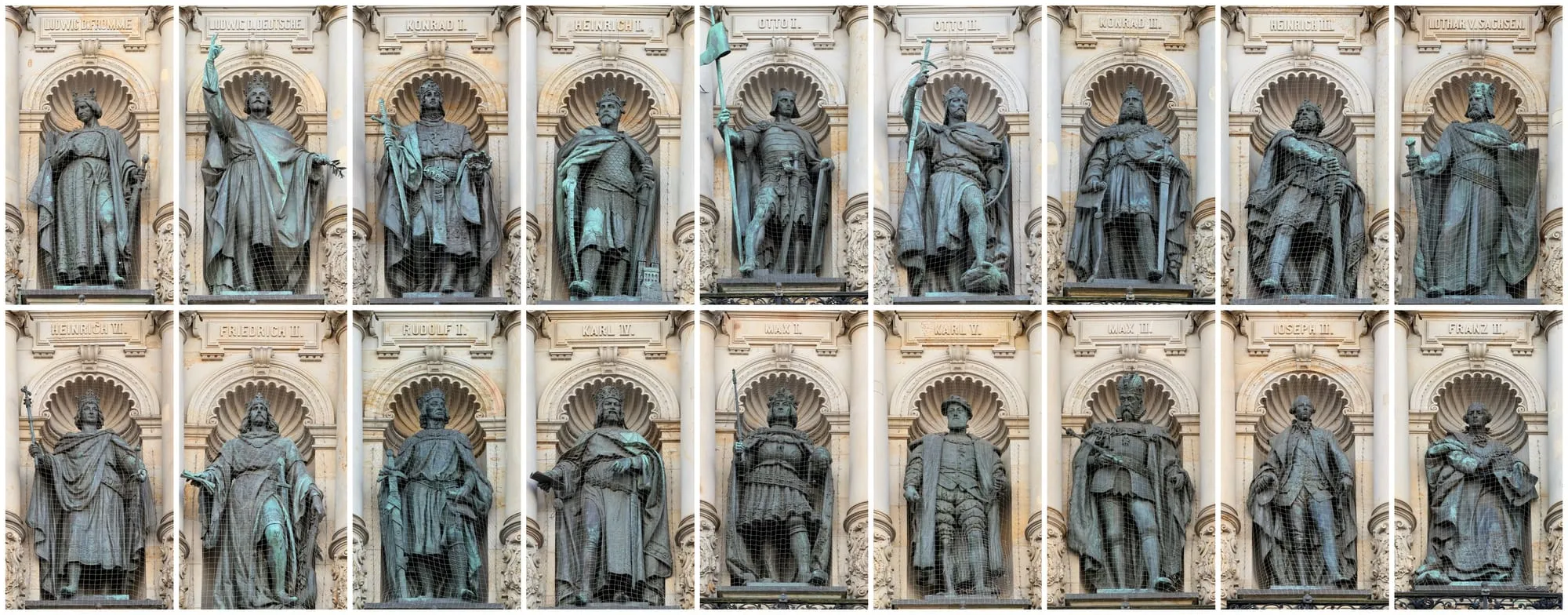
The Emperors
Right of the balcony, from Barbarossa outwards
- Heinrich VI (1190–1197): Barbarossa's son, who added Sicily to the empire through his marriage.
- Friedrich II (1212–1250): Barbarossa's grandson, who gave Hamburg to the King of Denmark in 1214 and whose seal is on the fake charter.
- Rudolf of Habsburg (1273–1291): The first Habsburg king, who brought order back after years without a strong ruler but was never crowned emperor.
- Karl IV (1346–1378): King of Bohemia, who made Prague his capital and wrote the Golden Bull of 1356, the rules for choosing kings.
- Maximilian I (1493–1519): Known as "the last knight", during whose rule Hamburg was officially counted as a free imperial city in 1510.
- Karl V (1519–1556): Maximilian's grandson and King of Spain, in whose time Hamburg became Protestant in 1529.
- Maximilian II (1564–1576): Karl V's nephew, during whose rule the English Merchant Adventurers settled in Hamburg in 1567.
- Joseph II (1765–1790): Maria Theresa's son, in whose time Denmark finally accepted Hamburg as a free imperial city in 1768.
- Franz II (1792–1806): The last Holy Roman Emperor, who gave up the crown in 1806 under pressure from Napoleon.
The virtues above the emperors
Hamburg gave Charlemagne and Barbarossa the place of honour, right above the main entrance. But above the emperors, the builders placed what mattered even more to them: Hamburg's own coat of arms and the four civic virtues.
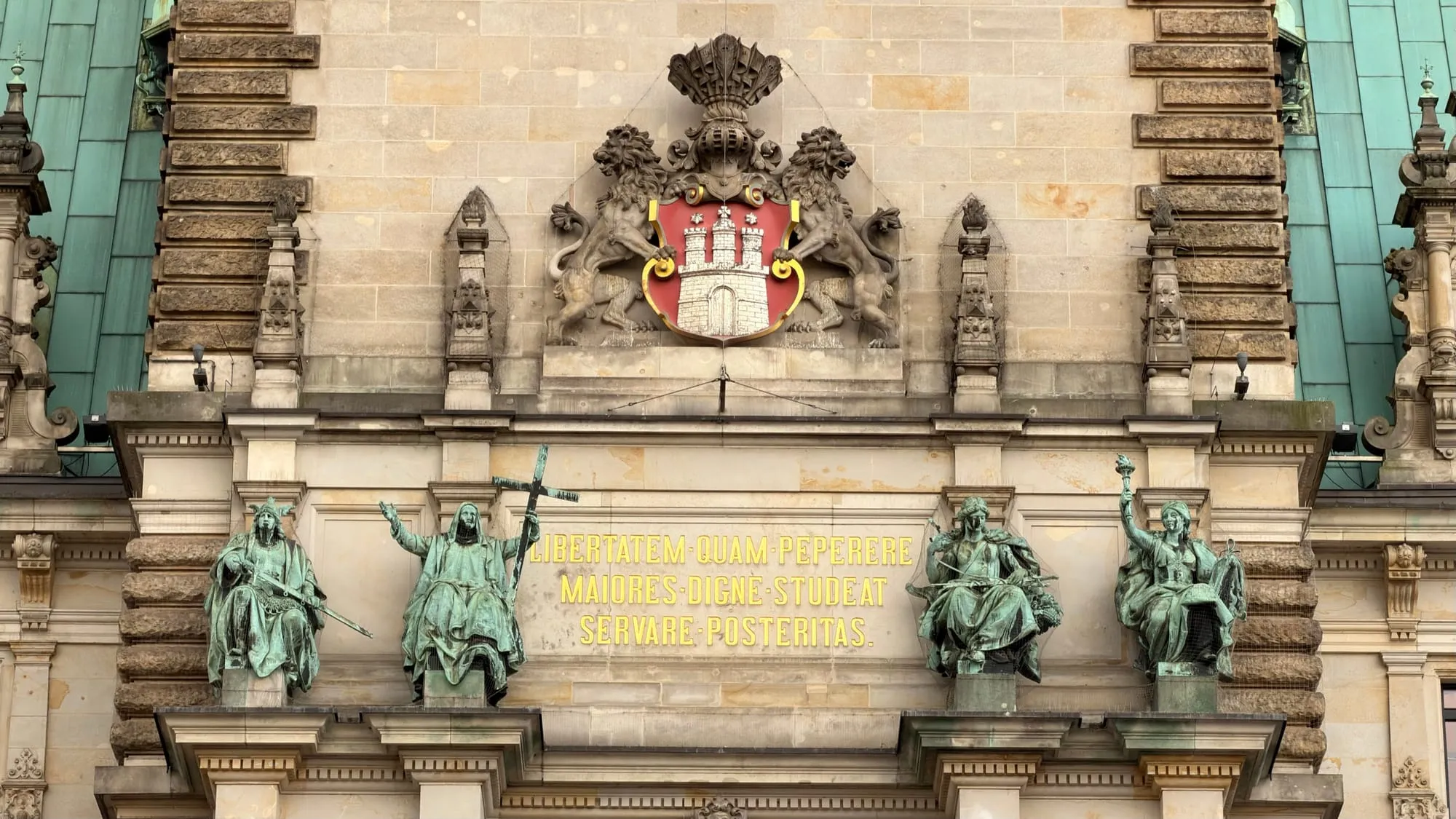
The coat of arms shows a white castle with three towers on red, with a cross and two stars above it, held up by two stone lions. You don't often see the coat of arms in this full form, with the lions and the helmet on top. The last time I saw it was embossed at the top of a letter I received from the Mayor of Hamburg, congratulating me on becoming a German citizen and on choosing Hamburg as my home. The interesting thing is that the letter talks about freedom, tolerance and trade, almost the same values Hammonia stands for.
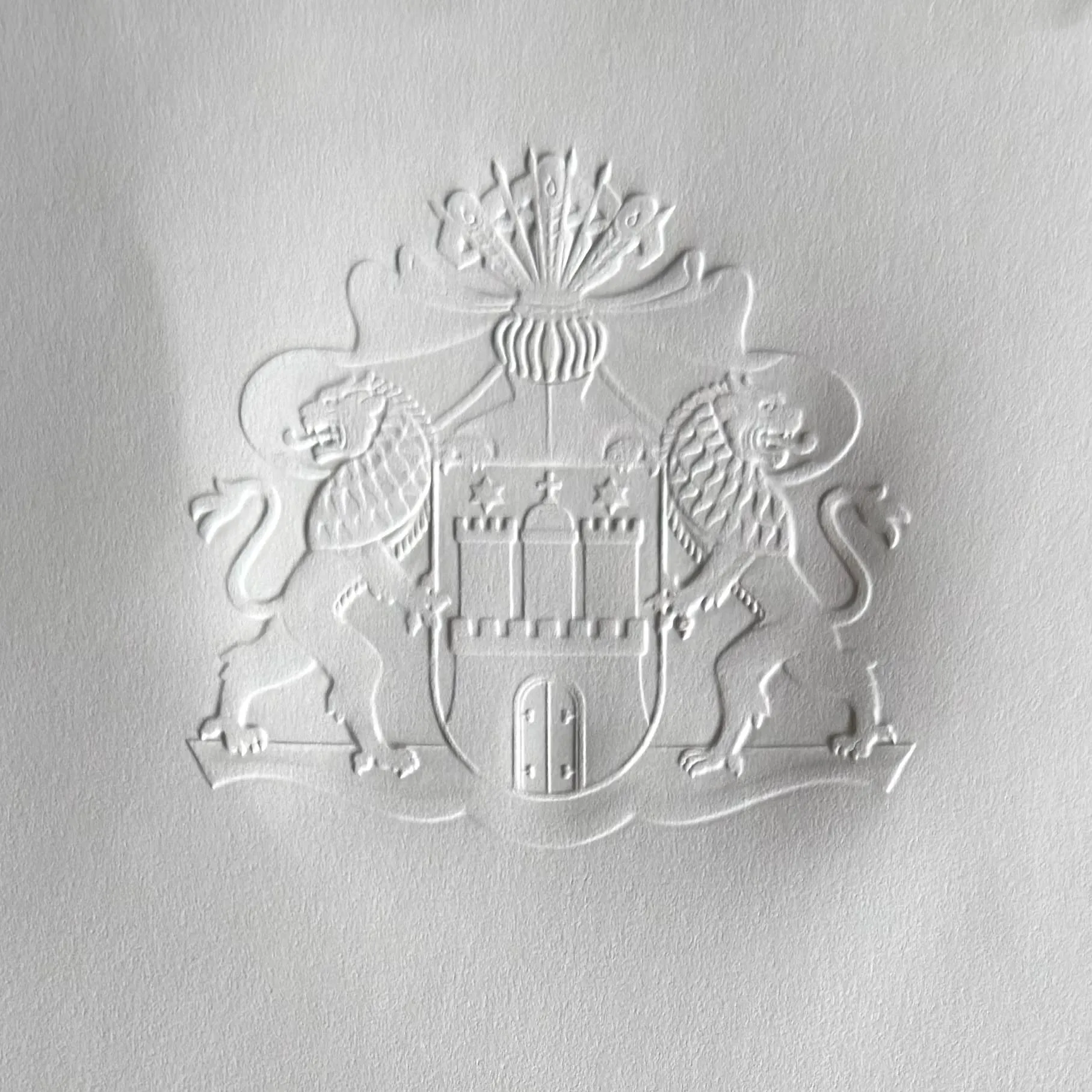
From the letter
Below it sit four bronze women, the virtues that, according to the builders, every Hamburg citizen should have. Courage wears a winged helmet and holds a sword, Piety raises a large cross, Unity has a sword lying across her lap, and Wisdom holds up a torch, standing for knowledge and good judgement.
Between them, in gold letters, runs the city's motto: "Libertatem quam peperere maiores digne studeat servare posteritas". It means "May the young generation be worthy of keeping the freedom that the old generation won." It sums up the whole building in one sentence: Hamburg is a free city, and its citizens have to look after that freedom.
The citizens above the emperors
Above Charlemagne and Barbarossa sit the virtues. Above the other 18 emperors, the builders went a step further and placed the citizens themselves. Over each of the 28 first-floor windows is a small triangular gable with a stone bust of a profession, from fisherman and baker to judge and banker. So along the whole façade, the people who made the city work sit higher than the rulers of the empire.
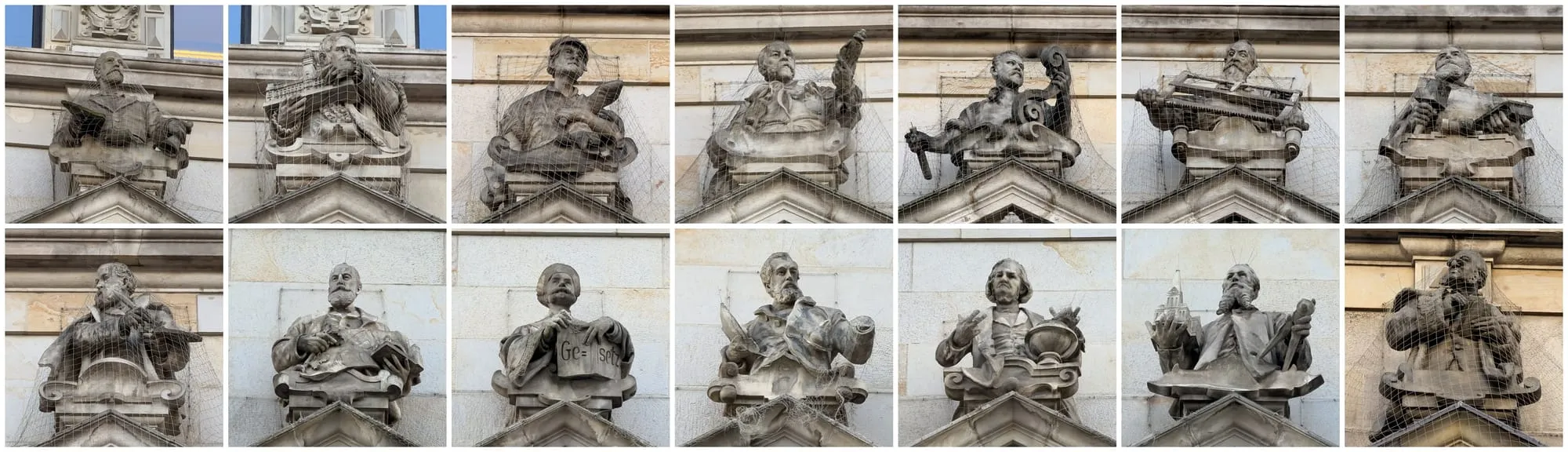
The sculptures modelled on real people
All 28 busts were made by the sculptor Aloys Denoth, and half of them were modelled on real people, from craftsmen to some of the best-known names of Hamburg at the time:
- President of the city parliament: Johann Georg Mönckeberg, holding a bell and a bill. Hamburg's main shopping street, the Mönckebergstraße, is named after him.
- Mayor: Carl Friedrich Petersen, who led the Rathaus building commission, holding a model of the Rathaus.
- Shoemaker: Master W. Knieriem, a shoemaker from St. Pauli.
- Sculptor: Engelbert Peiffer, Denoth's fellow sculptor, who carved the coat of arms with the two lions on the tower and the statue of Heinrich VI.
- Locksmith: the master locksmith Hermann Eggers.
- Cabinetmaker: Julius Rud. Loose, who had a workshop at Pulverteich.
- Potter: the master potter A.D.C. Warnstedt.
- Painter: the landscape painter Valentin Ruths, many of whose works are still in the Hamburger Kunsthalle.
- Engineer: Franz Andreas Meyer, the city's chief engineer, holding a model of a bridge. He planned the Speicherstadt and built bridges still in use today, like the Trostbrücke.
- Judge: Ernst Friedrich Sieveking, the first president of the Hanseatic Higher Regional Court, after whom the Sievekingplatz is named.
- Scholar: Justus Brinckmann, the founder of the Museum für Kunst und Gewerbe, holding objects from his collection. A cup he was holding has broken off.
- Teacher: the geographer Georg von Neumayer, after whom Germany's research station in Antarctica is named.
- Architect: Wilhelm Hauers, one of the architects of the Rathaus itself, holding a model of St. Johannis church in Harvestehude, which he designed.
- Fund broker: Eduard Behrens, a banker and art collector who gave paintings to the Hamburger Kunsthalle.
The other half show the everyday trades of the city: the fisherman, skipper and merchant, the tailor, baker, butcher, farmer and gardener, the shipbuilder, carpenter and mason, the pastor, a brewer or innkeeper with a cigar, and the chimneysweep.
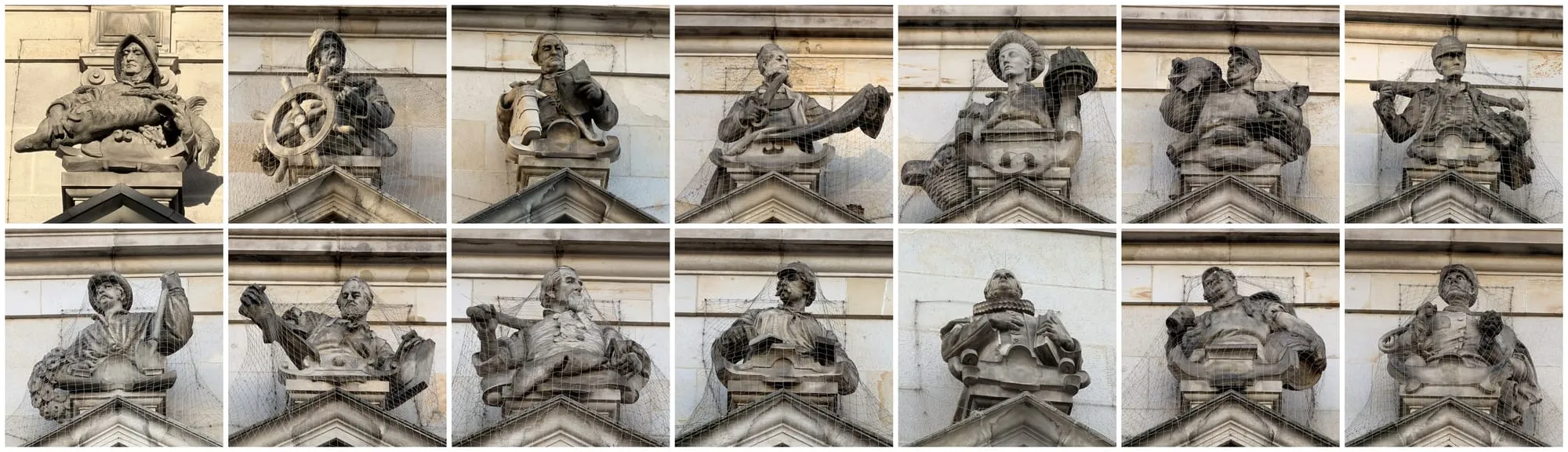
The rest of the sculptures
What surprised me most is how detailed they are. The baker holds a cake, the butcher has a pig's head, and the judge holds a law book. The sad part is that you can hardly see any of this with the naked eye. This is where you need a phone with a good camera: at 4x zoom, you can see what each of them is holding.
The coats of arms of the Hanseatic cities
Between the busts of the citizens and the emperors below them, each of the 28 gables carries a small coat of arms. Each one stands for a city of the Hanseatic League, or for a city that traded closely with it. Together they run around the building, from the Große Johannisstraße side, along the Rathausmarkt, to the Alter Wall side.
The Hanseatic League, or simply the Hanse, was a network of merchant towns that worked together to protect their trade. From the 13th to the 17th century it connected around 200 towns, from the Netherlands to the Baltic, with Lübeck as its leading city. The Hanse is so interesting that it would need its own article, but you can still see its traces in Hamburg today. The city's official name is the Free and Hanseatic City of Hamburg, and that's why Hamburg's number plates start with HH, for Hansestadt Hamburg.
Two of the coats of arms are bigger than the others: Lübeck on the left side of the front and Bremen on the right. They sit below the two most important busts, the president of the city parliament and the mayor, and it's probably no accident. Lübeck was the leading city of the Hanse, and when the league slowly faded away, Lübeck, Bremen and Hamburg were the last three cities that kept its name. Like Hamburg, they still call themselves Hanseatic cities, and their number plates still start with HL and HB.
Not every city on the façade was a full member. Amsterdam and Utrecht, for example, were trading partners rather than members. Florence is far from the North Sea, but its bankers, like the Medici, had offices across Europe, including in Bruges, one of the Hanse's main trading posts. A few of the coats of arms are not fully confirmed, Florence among them.
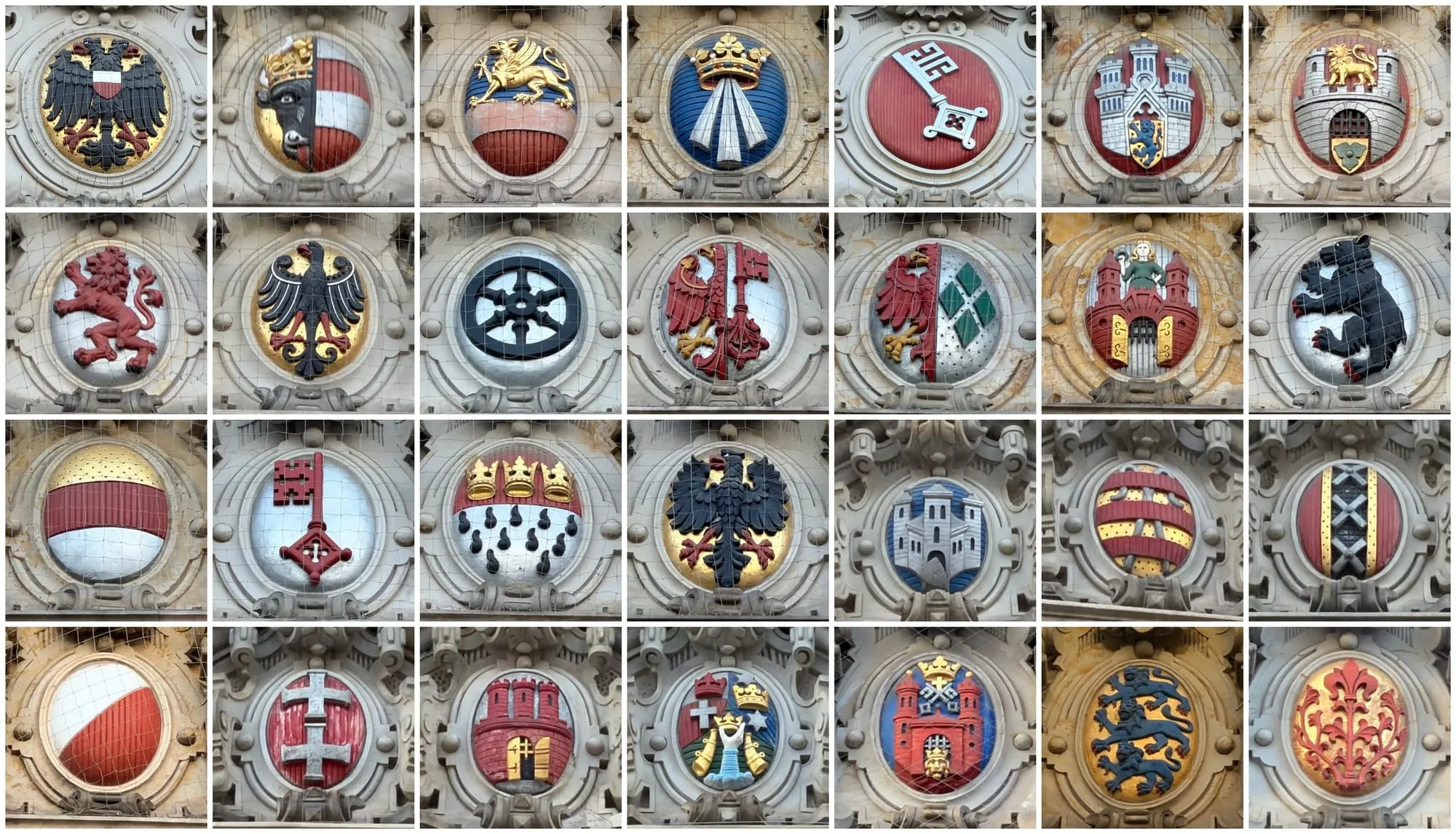
The coats of arms of cities
Here are all 28, grouped by where the cities are:
- The German Baltic coast: Lübeck, Wismar, Rostock and Stralsund
- Lower Saxony and Bremen: Bremen, Lüneburg, Hannover, Braunschweig, Goslar and Osnabrück
- Saxony-Anhalt and Berlin: Salzwedel, Stendal, Magdeburg and Berlin
- Westphalia and the Rhineland: Münster, Soest, Cologne and Aachen
- The Netherlands: Kampen, Stavoren, Amsterdam and Utrecht
- Around the Baltic Sea: Danzig (Gdańsk, Poland), Toruń (Poland), Königsberg (Kaliningrad, Russia), Riga (Latvia) and Tallinn (Estonia)
- Italy: Florence
The senators' families
Below the balcony that runs under the emperors, above the arched ground-floor windows, there is another set of coats of arms carved into the stone. These belong to Hamburg's own families. Until 1919, Hamburg was run by a Senate made up of men from the city's richest and most powerful families. They were chosen for life, not by a public vote, and 29 of these families have their coats of arms here.
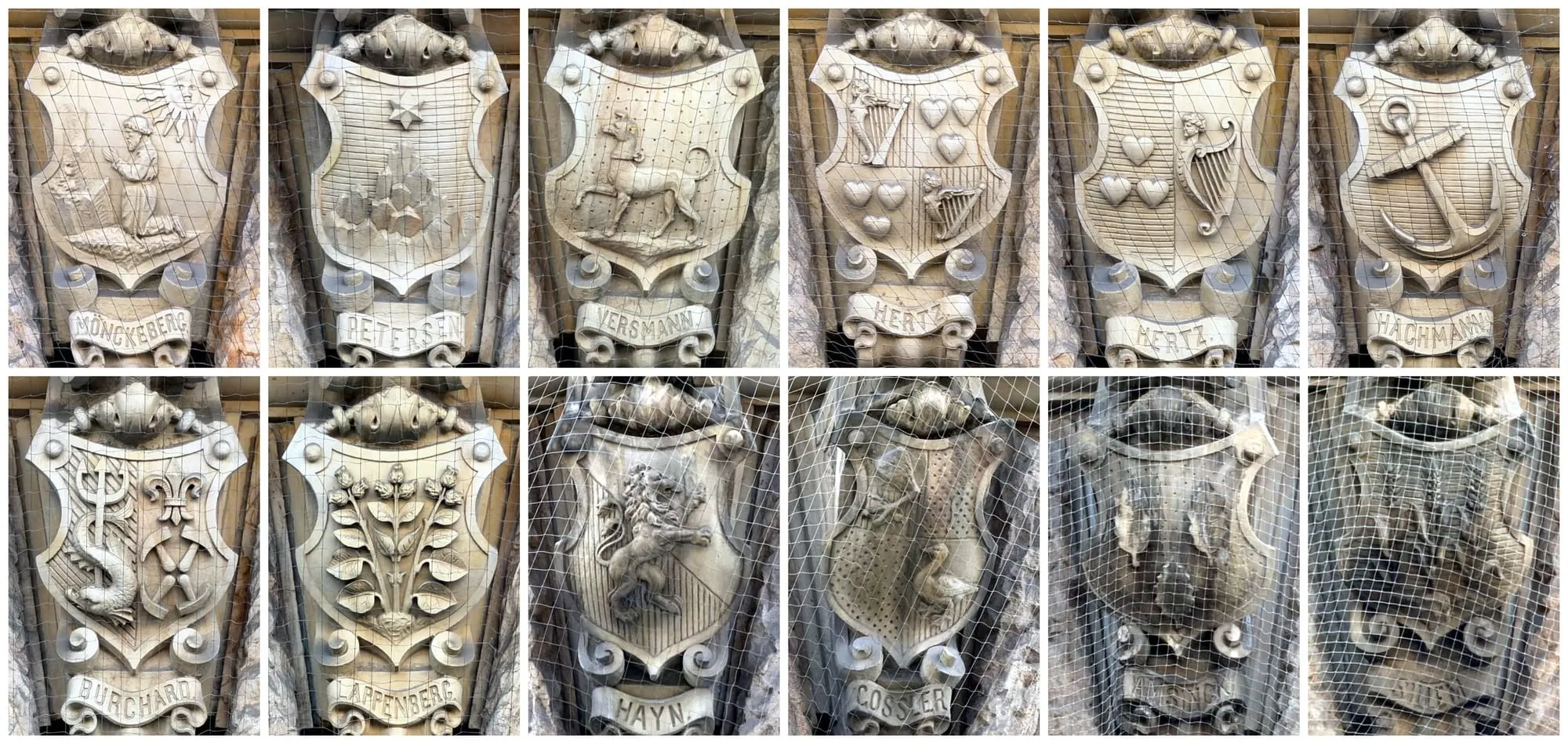
The coat of arms of families
You might not know their faces, but you probably know their names, because many of them live on in the city's streets, squares and parks:
- Mönckeberg and Petersen: the two mayors we already met among the busts.
- Versmann: Mayor Johannes Versmann, who led the talks that brought Hamburg into the German customs union in 1888. The Versmannstraße in HafenCity is named after him.
- Hertz: Senator Gustav Ferdinand Hertz was the father of the scientist Heinrich Hertz, after whom Hamburg's TV tower, the Heinrich-Hertz-Turm, is named.
- Hachmann: Mayor Gerhard Hachmann, after whom the Hachmannplatz next to the main station is named.
- Burchard: Mayor Johann Heinrich Burchard, after whom the Burchardplatz next to the Chilehaus is named.
- Lappenberg: Johann Martin Lappenberg, who looked after the city's old records and wrote its history. The Lappenbergsallee in Eimsbüttel is named after him.
- Hayn: Mayor Max Theodor Hayn, whose summer garden is today's Hayns Park in Eppendorf, where about 130 Alster swans spend the winter.
- Gossler: A family of bankers connected to the Berenberg bank, one of the oldest banks in the world. Goßlers Park in Blankenese was once the family's land.
- Amsinck and Sillem: Two trading families from the Netherlands, remembered in the Amsinckstraße and the Sillemstraße.
The others are the Abendroth, Bartels, Chapeaurouge, Geffcken, Kähler, Kunhardt, Lehmann, Merck, Möring, Moller, O'Swald, Roosen, Roscher, Schemmann, Schröder, Stahmer and Stammann families.
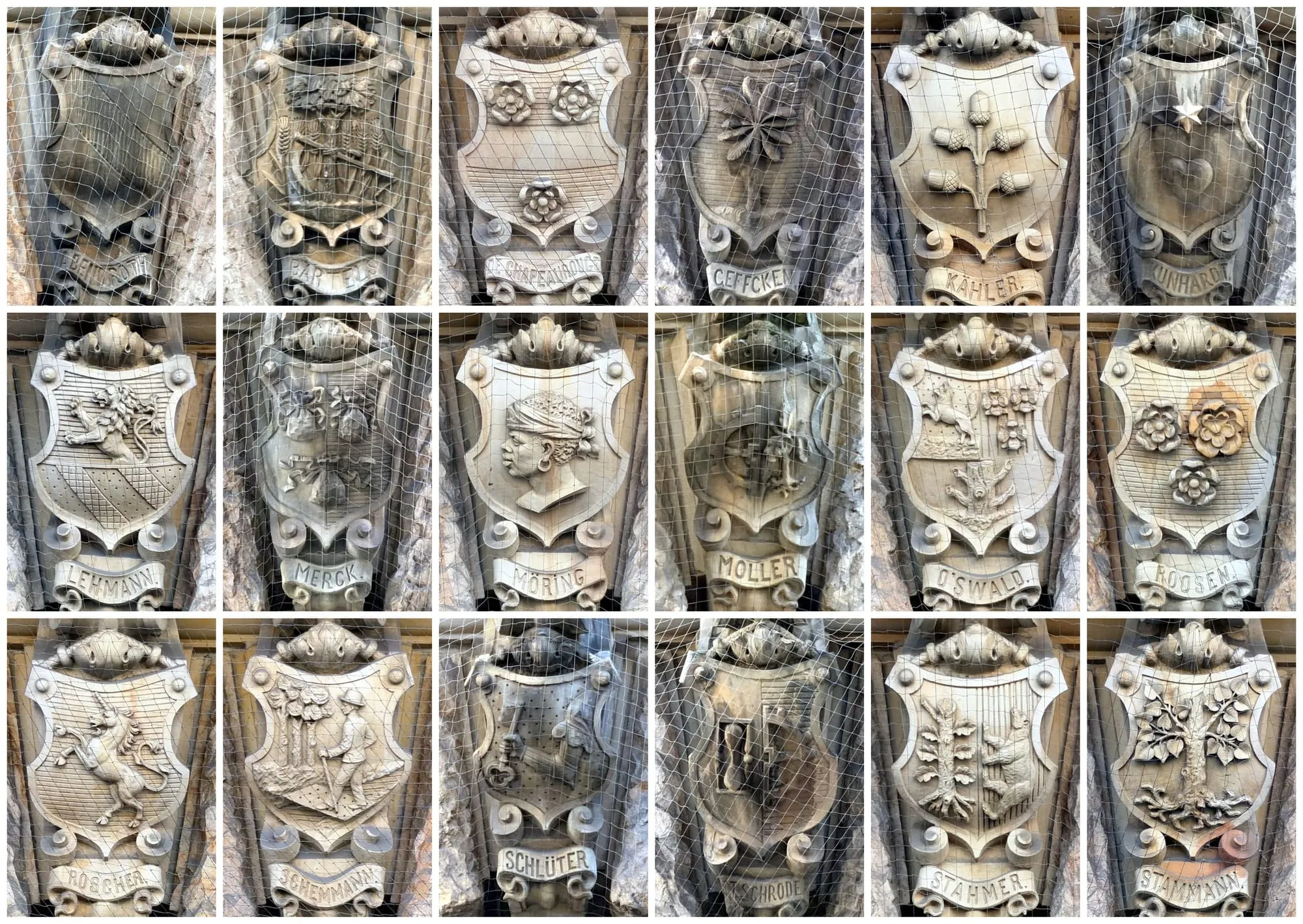
The coat of arms of families
Hayns Park is one of my favourite parks for a walk on a nice day. I usually go there after stopping by the French café Éclair au Café. I had always wondered where the park's name came from, and now I know.
The saints on the gables
Higher than anything else except the tower, nine saints stand on top of the large roof gables. Two of them hold the front corners facing the Rathausmarkt, St. Michael on the Große Johannisstraße side and St. Catherine on the Alter Wall side, and the others are spread around the sides and the courtyard. They are also the hardest figures on the building to see. From the ground they are just small shapes against the sky, and only at 8x zoom do they turn into figures with faces and the objects they hold.
Hamburg had been Protestant for more than 350 years when the Rathaus was built, so the saints aren't there to be prayed to. They stand for places. For centuries the city was divided into parishes, areas that each belonged to one church, and these parishes were also the basis of its politics: citizens met, voted and paid their taxes by parish. So the nine saints are really a map of old Hamburg.
Five of them stand for the city's five main churches, which you can still visit today: St. Peter for St. Petri, Hamburg's oldest parish church; St. Nicholas for St. Nikolai, the church of the merchants and sailors, whose ruined tower is now a memorial to the victims of war; St. Catherine for St. Katharinen by the harbour; St. James for St. Jacobi; and St. Michael for St. Michaelis, the "Michel", Hamburg's best-known church.
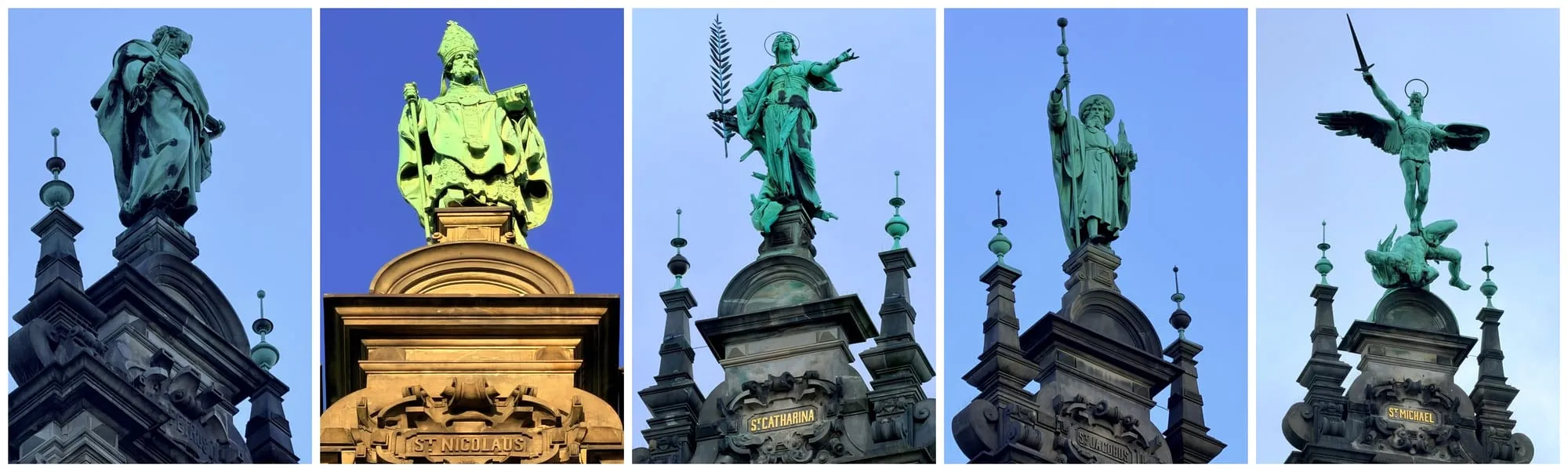
St. Peter, St. Nicholas, St. Catherine, St. James and St. Michael
The one that surprised me most was St. Michael. I know the Michel well: I've passed it many times and even lived close by for more than a year. But I had never imagined the saint behind the name, an archangel with big wings.
Two more stand for the old suburbs outside the city walls, St. Pauli and St. Georg. Both are still districts today, and it's interesting how far they have moved from the saints who gave them their names. St. Pauli, named after the apostle Paul, is known for the Reeperbahn and its nightlife, and St. Georg, named after the knight who killed the dragon, is known as the heart of Hamburg's gay scene.
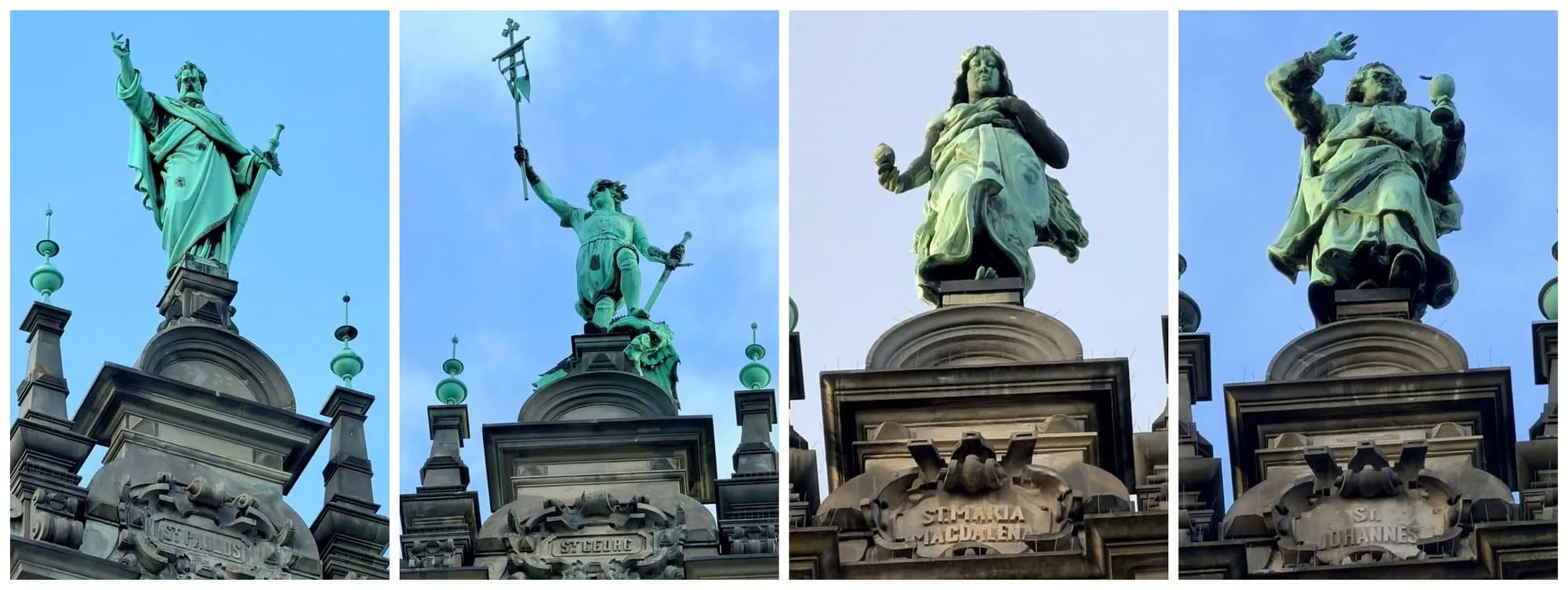
St. Paul and St. George, followed by St. Mary Magdalene and St. John
The last two stand for monasteries that are long gone: St. Mary Magdalene for the monastery that stood where the stock exchange is today, and St. John for the St. Johannis monastery near today's Rathaus, which still gives its name to the Große Johannisstraße.
The Orators and Justitia
The Rathaus is home to two different bodies: the Bürgerschaft, the city parliament, and the Senate, the city government. The parliament sits in the wing on the Große Johannisstraße side, and the Senate in the wing on the Alter Wall side. The figures on the two side façades show what each of them is about.
On the parliament side stand two orators, both made by the sculptor Friedrich Offermann. One is a young man in a Roman robe with the words "Plus ultra", meaning "More beyond". He stands for progress. The other is an old man with a book and a document and the words "Parta tueri", meaning "To protect what has been gained". He stands for conservatism. Together they show the two sides of every debate in a parliament: moving forward and keeping what already works.
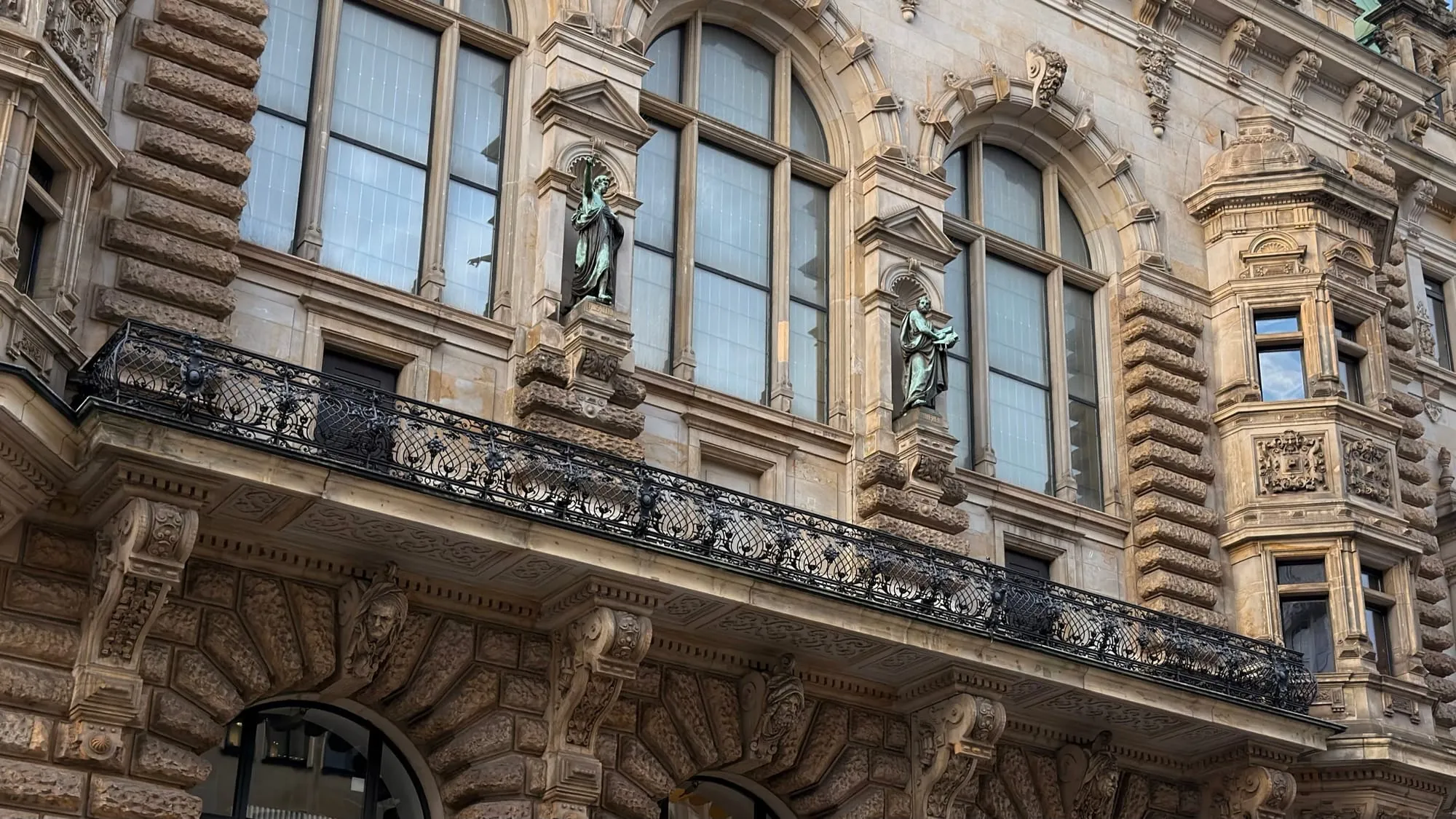
The Orators
On the Senate side sits Justitia, the figure of justice, also by Offermann. Today we would expect justice to sit with a court, not with the government. But until 1860, the Senate was not only Hamburg's government but also its highest court, so justice belonged right there.
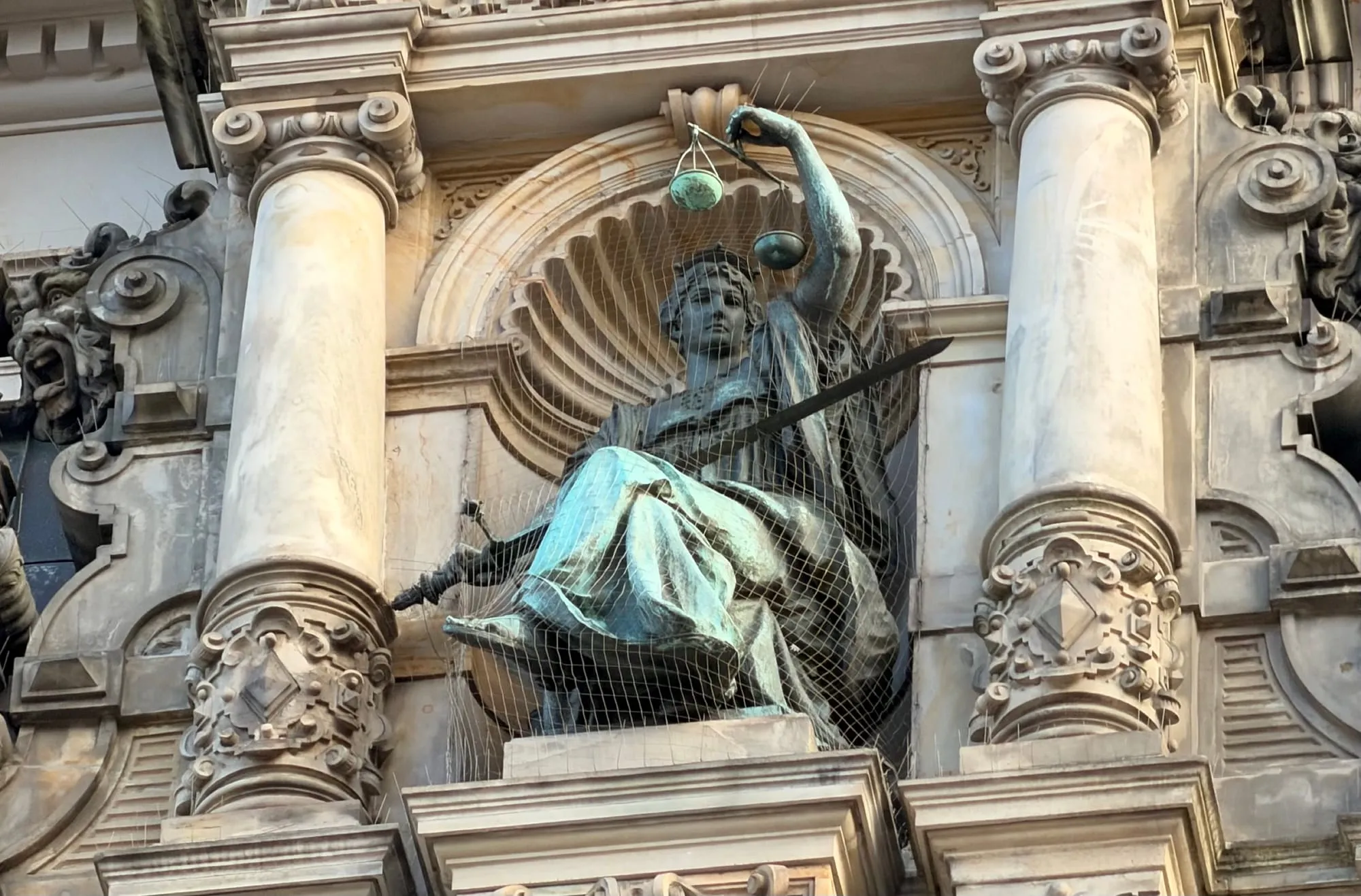
Justitia
The courtyard
Behind the Rathaus is a courtyard it shares with the stock exchange, open to everyone from the Große Johannisstraße and the Alter Wall. It's much quieter than the Rathausmarkt, and the figures here tell an older story.
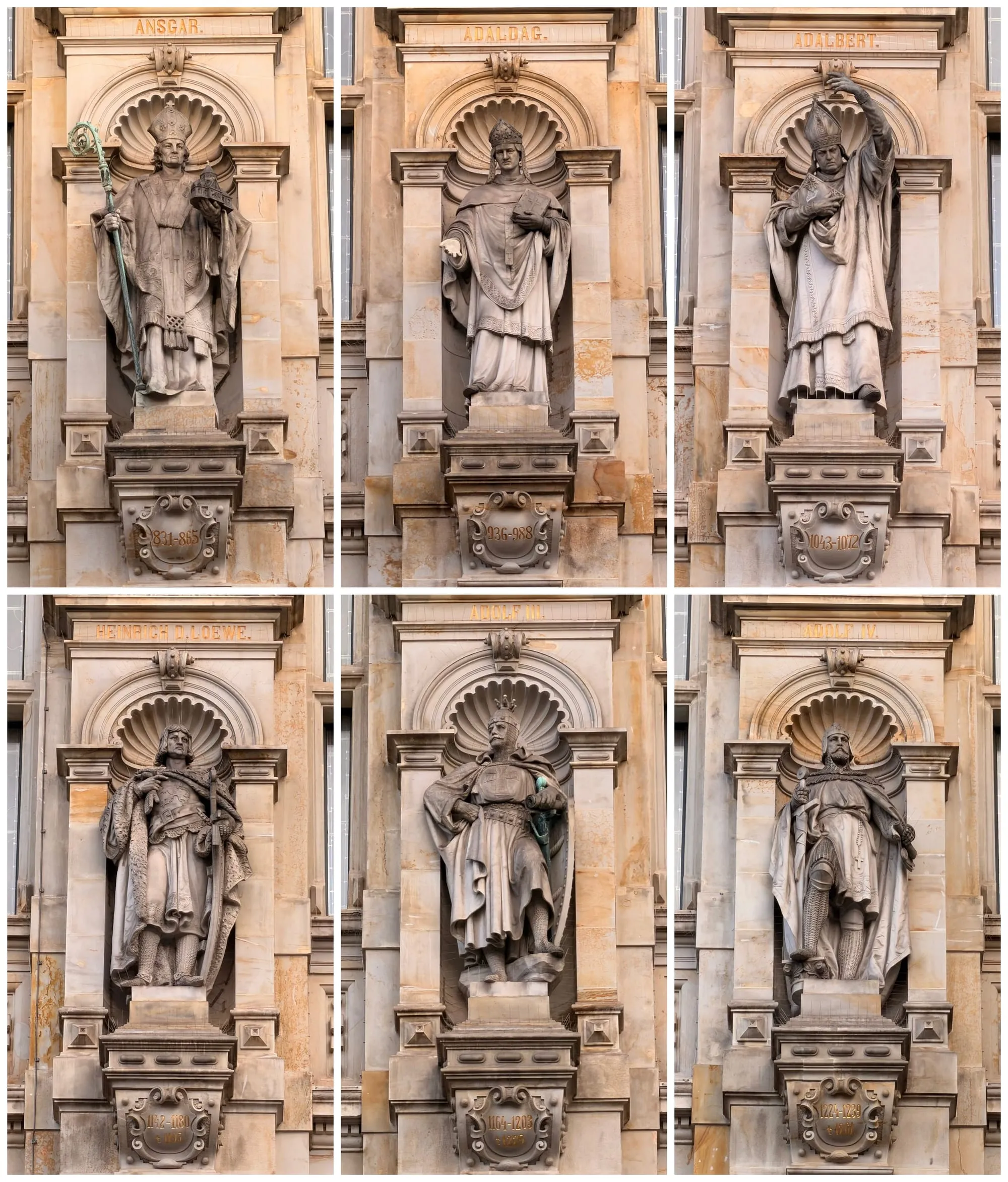
The early founders
In niches about 12 metres up stand six men who shaped Hamburg long before it became a free city: three archbishops, who made it a centre of the church, and three rulers, who helped it become a trading town. Some of them we already met through the emperors on the front.
- Ansgar (archbishop 831–865): The first archbishop of Hamburg, appointed under Ludwig the Pious and sent to bring Christianity to Denmark and Sweden. He is often called the "Apostle of the North".
- Adaldag (archbishop 936–988): He led the archbishopric of Hamburg and Bremen for over 50 years, with the protection of Otto I.
- Adalbert (archbishop 1043–1072): Heinrich III's close adviser, under whom Hamburg-Bremen became one of the most powerful church seats in the empire.
- Henry the Lion (Duke of Saxony 1142–1180): Hamburg lay in his duchy, and he helped the trading towns of the north grow, above all Lübeck.
- Adolf III of Holstein (count 1164–1203): Around 1188 he started a new settlement for merchants next to the old town, and he is the count who got Barbarossa's promise of free trade on the Elbe.
- Adolf IV of Holstein (count 1224–1239): He ended Danish rule over Hamburg at the Battle of Bornhöved in 1227 and founded the Maria-Magdalenen monastery, the one remembered by St. Mary Magdalene on the gables. Later he became a monk himself.
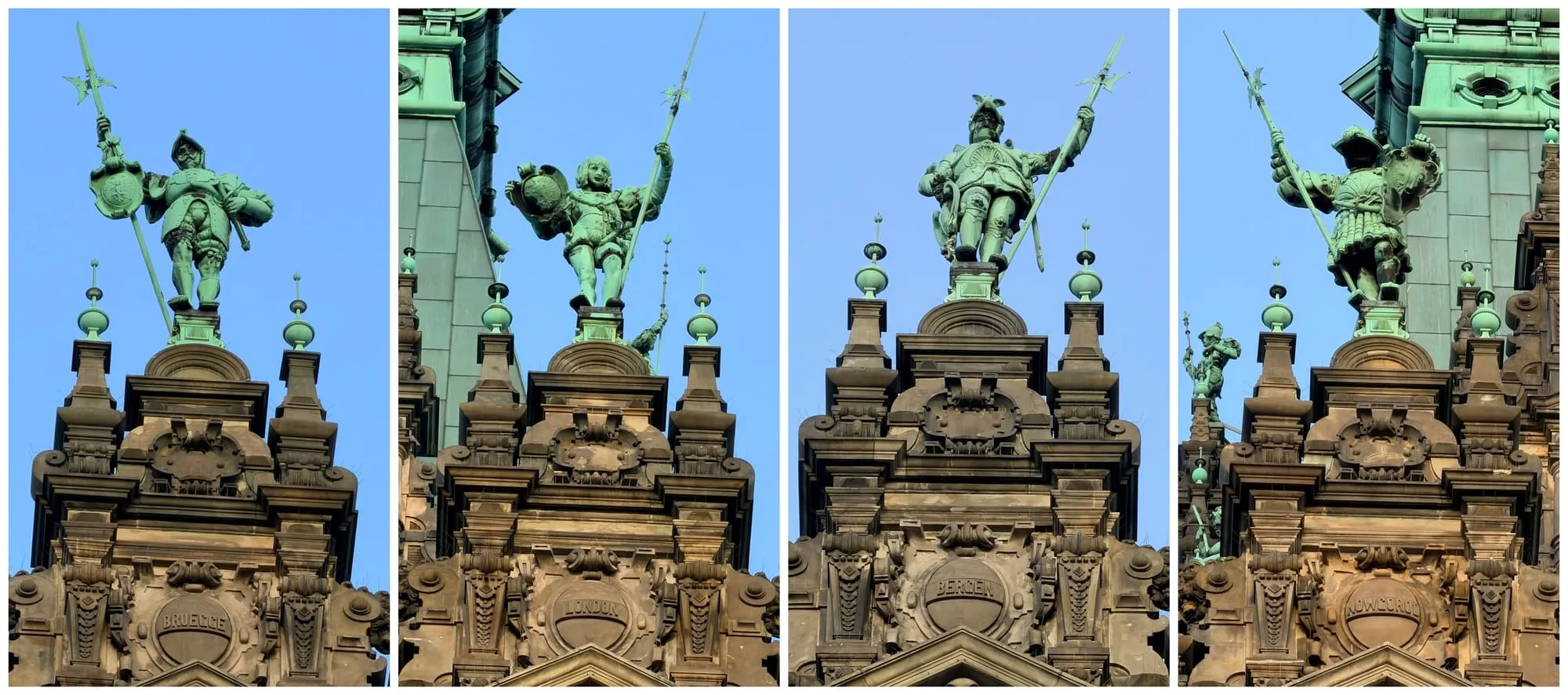
Higher up, on four smaller gables, stand bronze shield-bearers, most of them in 16th-century armour, each holding a halberd and a shield. The round medallions below them carry four names: Bruegge, Nowgorod, London and Bergen. These are not member cities but the Hanse's four big trading posts abroad, called Kontore. In each of them, Hanseatic merchants had their own rules and trading rights, and everywhere except Bruges, their own walled quarter with warehouses and living quarters.
- Bruges: The trading centre of Flanders, where the merchants bought Flemish cloth and met traders from France, Spain and Italy.
- London: The Steelyard on the Thames, where they traded English wool and cloth, until Queen Elizabeth I closed it in 1598.
- Bergen: Bryggen, the harbour quarter at the centre of the trade in dried cod from northern Norway. Its wooden buildings still stand today.
- Novgorod: The Peterhof, where they bought furs and wax from Russia, until Ivan III of Moscow closed it in 1494.
In the left corner of the courtyard is a doorway that was meant for weddings. Above it sits Hymen, the god of marriage, with two torches, and on either side stand Adam with a dog and Eve with an apple and the snake. The figures were made in 1896 for a wedding office that was supposed to move into the Rathaus, but it never did, so the gate has never been used for a single wedding. Couples can marry in the Rathaus today, in the Phoenix Hall once a month, just not through this door.
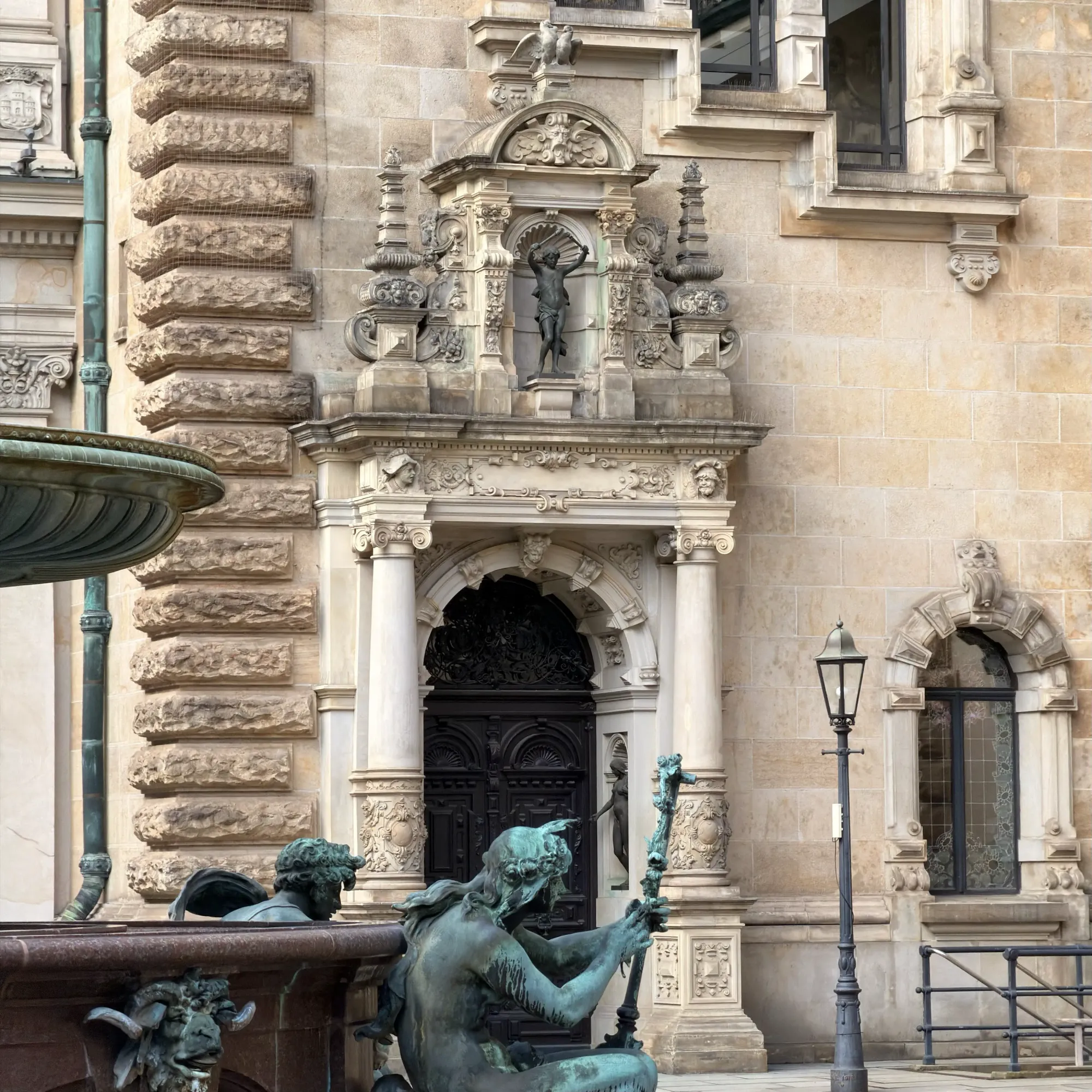
The wedding door
In the right corner, above the kitchen window, sits a small carved kitchen boy, licking a spoon and holding a fork. It's one of the smallest details on the whole building and very easy to walk past.
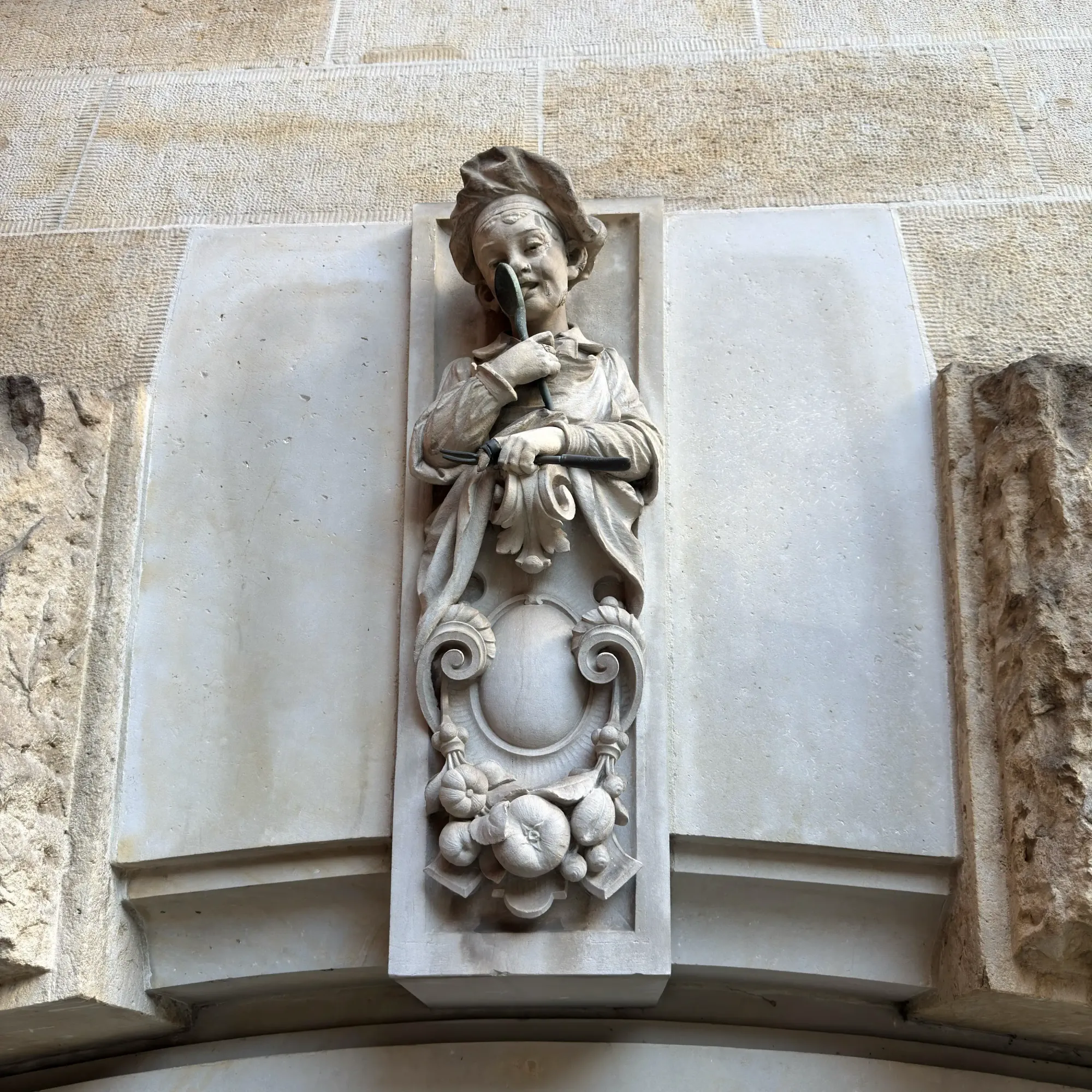
The kitchen boy with a spoon
In the middle of the courtyard stands the Hygieia fountain. It was built in 1895–1896 to remember the cholera epidemic of 1892, when more than 8.000 people in Hamburg died, mostly because of unclean drinking water. The first plan was to show Mercury, the god of trade, but after the epidemic the city chose Hygieia, the Greek goddess of health, instead.
Hygieia stands at the top, holding a small bowl of clean water, with a dragon at her feet that stands for the defeated cholera. Around the basin below sit six bronze figures showing how people use water, such as a man with a ship for shipping, a man with a fish for fishing and a woman with a jug for drinking water.
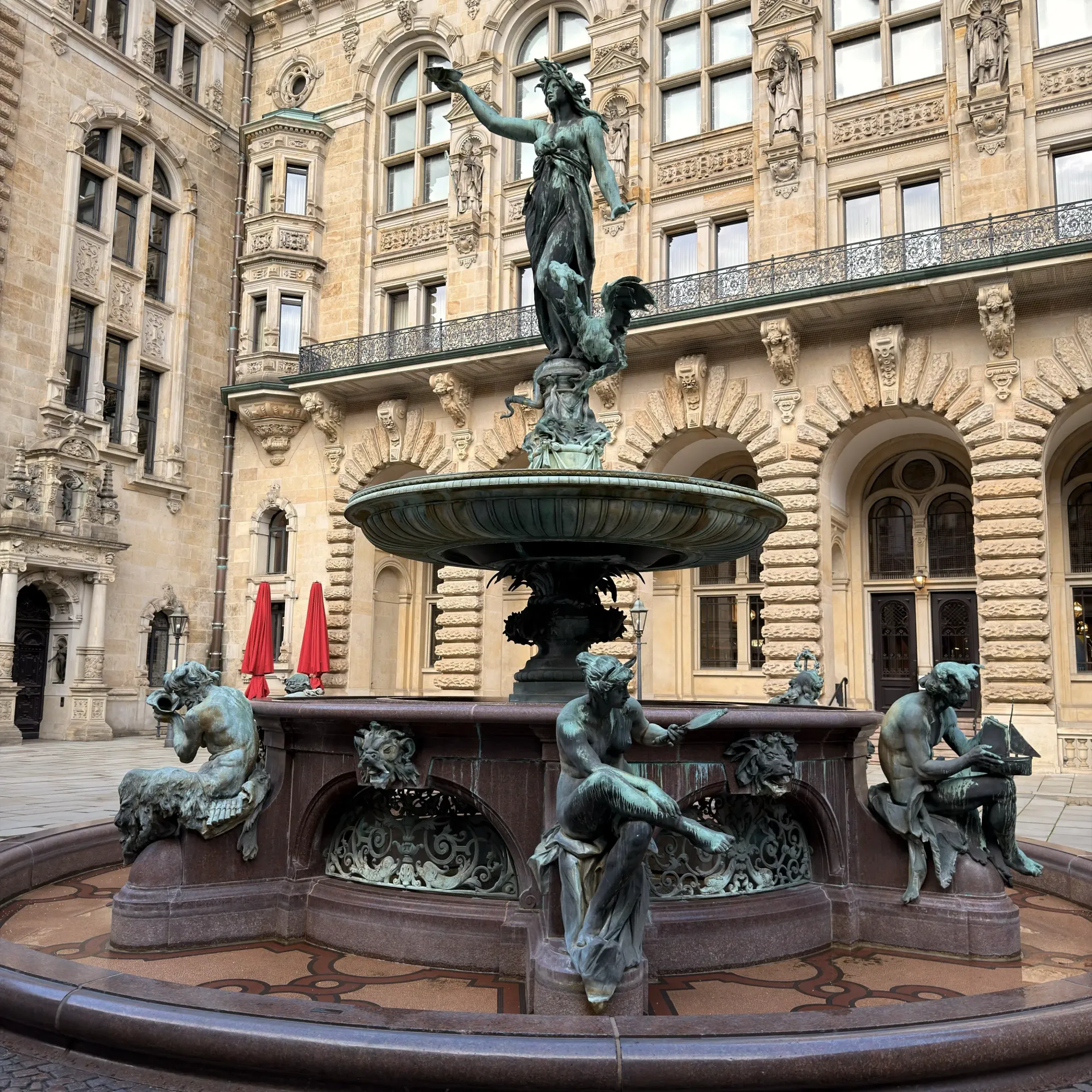
The Hygieia Fountain
The best detail is hidden in the base. Between the figures hang bronze faces, each above an arched opening with a grille. These openings are the air intakes of the Rathaus ventilation system: air was drawn in over the water, which helped cool the building. So the fountain is not only a memorial, but also part of the building's air conditioning.
Standing in the courtyard, I always imagine it busy with senators and merchants, talking next to the fountain between a meeting in the Rathaus and a deal at the stock exchange. You have to admire how transparent the city is: the government and the stock exchange share one courtyard, so at least nobody can say they didn't know whose interests the decisions were made for.
Still more to see
Even after all this, there are many details I haven't covered, and I haven't even gone inside: the Rathaus has 647 rooms, and its halls and staircases are full of paintings and carvings that would need an article of their own.
I'm not sure there is another town hall in Germany that tells the story of its city in this much detail, from the emperors and saints to the fishermen, bakers and a kitchen boy licking a spoon. Almost every figure was chosen for a reason, and many of them point to something you can still see in Hamburg today.
While researching this article, one book kept coming up again and again: Das Hamburger Rathaus by Heinz-Jürgen Brandt, from 1957, which describes the building's history, architecture and decoration in detail. When I tried to buy it, I found out it's no longer in print, and in the end I ordered a second-hand copy for a much higher price, which I'm really looking forward to reading. There is a newer book, Das Hamburger Rathaus: 125 Jahre – 125 Geschichten by Rita Bake and Michael Zapf, published for the building's 125th birthday in 2022, but I'm not sure it covers the façade in as much detail as the old one.
This wasn't the first time I've had this problem. Whenever I want to go deeper into a part of Hamburg's history, the best books are often out of print, and second-hand shops are the only way to find them. When I first wanted to learn about the city's history, I couldn't even find a single book written in English.
I'm not sure the city is aware of this, but I believe that if these stories aren't told, they will slowly get lost. And if people don't know the stories behind the places they pass every day, they probably won't feel as connected to their city. This article is my small attempt to keep some of them alive.