Martin Amis and The War Against AI
The late novelist was a fierce enemy of cliché and would have delighted in skewering Claude and ChatGPT
Sir Martin Amis would have turned 77 this summer were it not for his untimely death three years ago.
I stand by that word ‘untimely’, because for every fresh medley of horrors the world has served up since, there is a line that only Amis could have written that would have reminded us all of the power of original thought, and without which we continue to be worse off.
What Amis would have made of Donald Trump’s second term as president, the Gaza war, or the ongoing climate crisis can be surmised from his existing output. Though his pen never got to puncture large language models (LLMs), we can be sure that he would have roundly mocked Claude and ChatGPT had he lived long enough to see them win literary prizes.
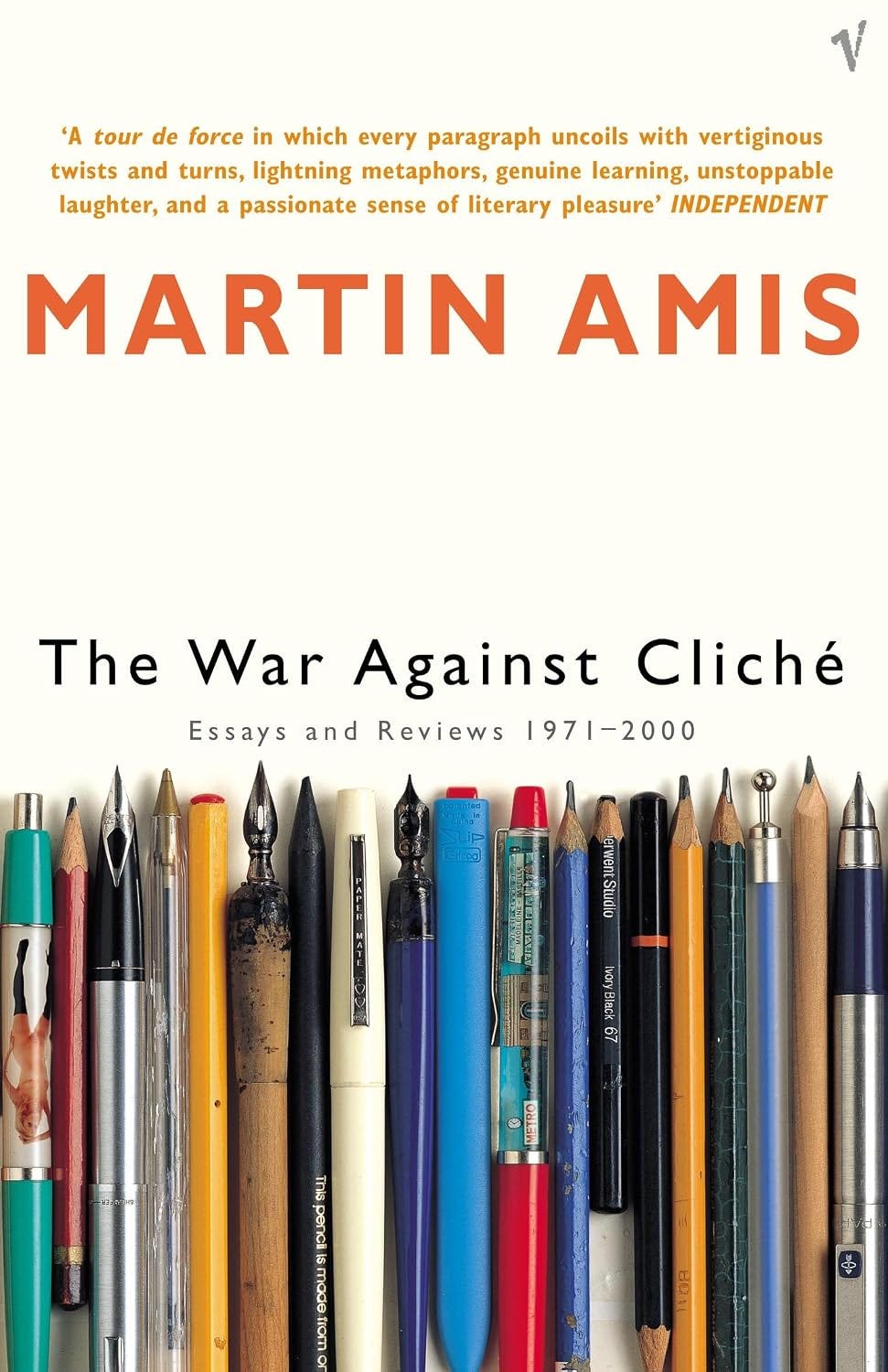
Amis was, after all, the writer who took the very act of writing to task in The War Against Cliché , his celebrated collection of reviews and essays published at the turn of the millennium. It is this book more than any other that has formed the focal point of conversations in My Martin Amis , a podcast I launched about his legacy in 2023, shortly after he died.
Yes, Amis’s big three London novels — Money (1984), London Fields (1989) and The Information (1995) — will always get his readers’ veins pumping. But it’s his war cry in support of originality and intellectual independence that the series reveals was his greatest gift to writers who spend their days uttering aloud the same sentences over and over again until they’re cleansed of “anything that smells of the flock and the sheep dip”, as Amis so deftly put it in his last novel, Inside Story (2019).
I was reminded of The War Against Cliché again last month when the Irish novelist Kevin Power, speaking at the podcast’s second annual live event in London on August 25, described the invasion of AI into literary culture as a major coup for clichés. “LLMs have almost certainly been trained on the prose of Martin Amis, but that has had no effect whatsoever on the prose generated by LLMs, much as Amis’s criticism has had no effect whatsoever on the prose generated by most writers,” he said.
Power added: “I do a lot of book reviewing…and I can’t believe people haven’t heard the news. Don’t you know there’s a war on? Why are you still using so many clichés?” ‘The War Against Cliché,’ by Martin Amis, published in 2001.
A senior writer at the FT Weekend, Will Lloyd , added that journalism has changed a great deal since Amis’s pomp in the Eighties, where the ink spilled on allusions to novelists and their work added appreciable heft to the Sunday newspaper. The adrenal nature of online engagement may have sped everything up, turning what was once a Rolls into a dragster, but Lloyd said this only sharpens the lessons he takes from Amis’s career.
“[Amis] worked really, really hard, and he wanted to be different,” he said. “To do that, he had to be this quite irritating striver, and you can see why it annoyed so many people. Not only was he a lot more talented than a lot of people, he worked a lot harder than them.”
“The tidal pressures are always in favour of cliché,” Power later said. “LLMs represent an increase by an order of magnitude in that pressure against original seeing and original saying.”
Both Power and Lloyd are right of course. In Amis’s war, LLMs are biological weapons that eviscerate human grey matter at scale. Writers, Amis argued, should be wary even of subvocalising cliché. To ask AI to come up with a less predictable phrase on their behalf is to bypass altogether what he called “herd thinking” and approach something closer to self-induced brain death.
I’m not suggesting that writers have given up the fight, only that our defences are down and require a serious upgrade. If you doubt this, consider the steadily emptying clown car of AI-assisted screwups we’ve witnessed so far in 2026.
There was the case in March of Alex Preston, the freelance critic who the New York Times cut loose after finding strong traces of another critic’s article in one of his book reviews. There was the piece Sports Illustrated ran in May that it transpired was mostly lifted from analysis published in Sportico two days earlier. That same month in the UK, The Daily Telegraph pulled an online story that had left AI-generated notes in the copy advising two subheads to “maintain that authoritative, broadsheet pace”. Why after 171 years in print the paper felt it needed AI to tell it how to read like The Daily Telegraph is anyone’s guess, but it certainly sounds like cliché won the battle there too.
And then there’s the new order of fraudsters using AI to pose as newspaper columnists. Alys Denby , opinion and features editor of the London paper City AM, and former guest on My Martin Amis , knows all about that. In June she wrote about being “deluged” with AI-generated columns from otherwise reputable PR agencies, a daily scourge that eventually pushed her to write a field guide to spotting “AI slop-eds.”
But perhaps the biggest victory for cliché this year was Jamir Nazir’s The Serpent in the Grove , which won the Caribbean regional prize in the Commonwealth Short Story Prize in May, and was subsequently published in the esteemed literary mag Granta. The story emerged bristling with red flags from AI sleuths on X and Bluesky, and after much vexed investigation, was left a bewilderingly open case by both the judges and the publisher.
It would be a terrible mistake to imagine that Amis thought the war against cliché could be won by any means. For him, good writing was not just a matter of what writers put on the page, but of the internal disciplines and prompts supplied by what he called the “mind’s ear.” Amis was explicit about the fact that writing happens mostly at the level of the subconscious, so that any difficulties a writer encounters must either be resolved through force of will — a solution favoured by the younger Amis — or by allowing the mind to dredge up the answer unprompted, a process he later called a kind of “white magic.”
Ever since August’s event, I’ve been trying to figure out what is drawing new guests and listeners to the My Martin Amis podcast. My sense is that this series that began as a vigil has since come to represent a live issue about the future of literary style, discipline, and above all, courage. Amis was a bastion of all three virtues, and did his best to show us a way to cultivate them.
But if writers were losing the war against cliché before the age of AI, the temptations of these new technologies already make it likely we’ll see white flags jutting up above the trenches in 2027 and beyond.
So long as we understand cliché as outsourced thought that dissolves accountability, LLMs will only ever produce clichés. We owe it to Amis to put up a better fight against these lesser minds, and their evangelists, than we have so far this century.