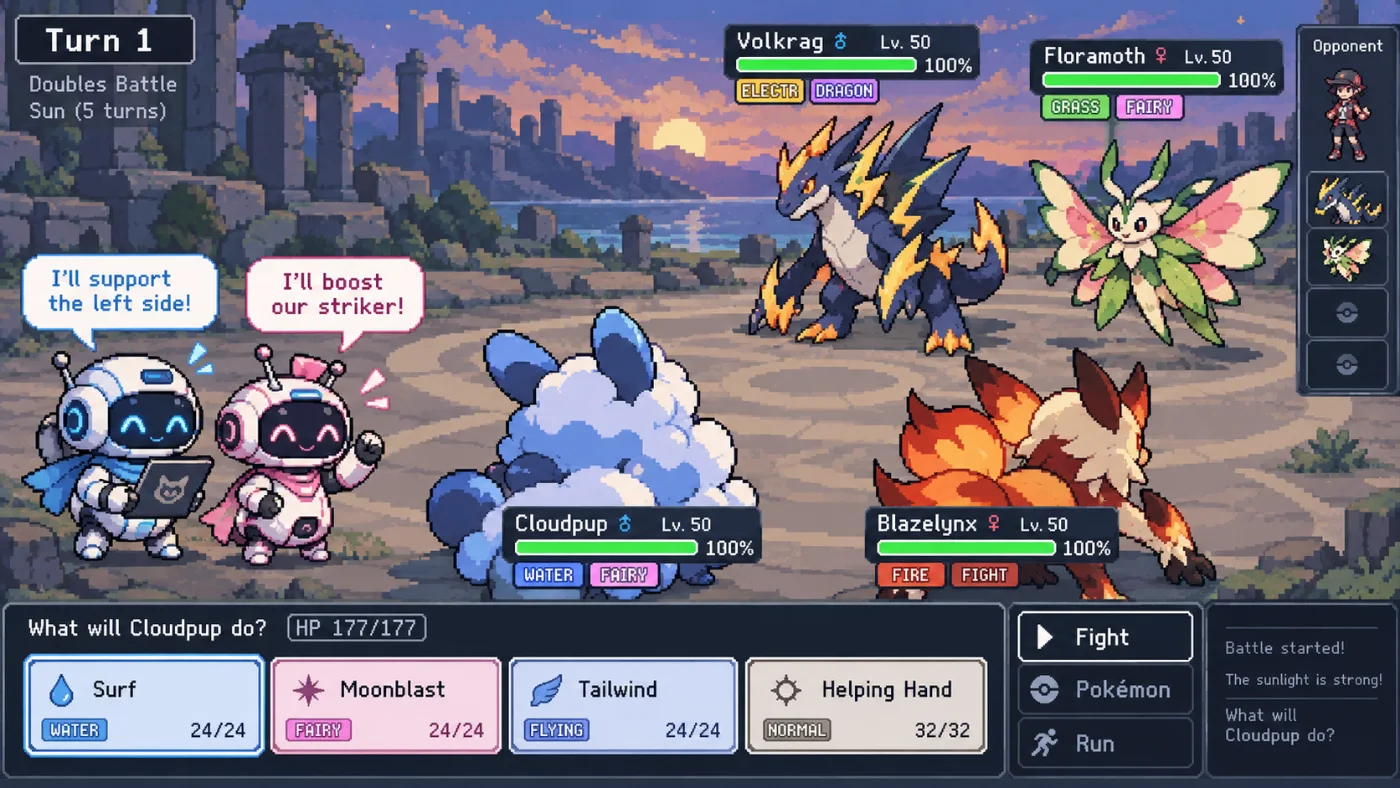
The future is in LLM collaborations, and it is important to be able to understand how good agents
are at working together, communicating and negotiating actions. Most multi-agent research is about
workflows, where agents pass tasks down a pipeline
(Hong et al., 2024;
Qian et al., 2024). To test this, I built a multi-agent
environment on Pokémon Showdown's 2v2 format to evaluate these abilities.
"Both opps are Water types … so my Fire moves are resisted on both. … I plan to Wisp
Dondozo … can you open with Fake Out to flinch one of them this turn?"
Qwen3.8-27B - Player 2
"Good call on Wisp-ing Dondozo. Quick correction though - Fighting isn't actually resisted
by Water or Ground, so my Close Combat is neutral (1x) on both. … Locking in Fake Out →
Whiscash."
Qwen3.8-27B - Player 1 chose Will-O-Wisp → opposing Dondozo (p4)
Qwen3.8-27B - Player 2 chose Fake Out → opposing Whiscash (p2)
Turn 1 of a real battle between two Qwen3.8-27B teammates (excerpts). They split targets, and
one corrects the other's type-matchup mistake before committing.
Watch the full battle with team chat.
Why Pokémon?
Pokémon doubles is a game-theory environment without full information. The opponents' sets are
hidden and damage is random, so winning takes real strategy: reading the other team, splitting
targets and planning around your partner. Recent work like the PokéAgent Challenge
(Karten et al., 2026) benchmarks Pokémon battling,
but each side is played by a single agent, and specialist RL agents still outplay general LLMs
there. It doesn't test teammates who have to coordinate.
The goal is a controlled environment where I can measure how LLM agents coordinate, and that can
later be used to train them with RL to encourage these collaborative behaviors.
Methodology
Environment
The official Pokémon Showdown simulator, wrapped as a Gym-style environment. Four players each
control one Pokémon from a team of three, two per side.
Agents
Each turn, an agent reads a plain-English summary of the battle and a numbered list of its legal
moves. It can say a private message to its partner or choose a move, and
once it chooses, its partner is told what it picked.
Talk modes
Free talk (keep talking until both have chosen), one message each, no talk, and one model
controlling both Pokémon.
Evaluation
Qwen3.8-27B plays both teammates against a scripted max-damage bot. Battles are seeded and every
team draw is played from both sides, so each talk mode faces exactly the same battles.
Results
Win rate by talk condition vs. max-damage bot baseline
| Condition | 30%50%70% | | Tokens per battle |
|---|
| Free talk | | 64% | 978k |
| One model controls both | | 54% | 450k |
| One message each | | 52% | 654k |
| No talk | | 42% | 259k |
Talking helps. Teammates who could talk freely won 64% of their battles against the max-damage
bot, while teammates who couldn't talk at all won 42%. Even a single message each (52%) beat no
talk. One model controlling both Pokémon (54%) did better than no talk but worse than two agents
talking freely, so I think the gain comes from the conversation itself, not just from one mind
planning both moves.
Talking also costs. Free talk used 978k prompt tokens per battle, 3.8x the 259k of no talk, since
every message means another model call that re-reads the battle and the conversation so far.
Qwen3.8-27B team with free talk, against
| Opponent | Win rate | |
|---|
| Qwen3.5-2B team | | 96% |
| Qwen3.5-9B team | | 74% |
| Max-damage bot | | 64% |
I also checked that the environment can tell models apart. A Qwen3.8-27B team won 96% of its
battles against a team of 2B models and 74% against a team of 9B models, compared with 64% against
the max-damage bot. The stronger the opponent, the closer the games, which is what makes the
environment usable as a benchmark for comparing models.
Next
I'm separating the effect of talking from the effect of seeing your partner's move. I'm also
looking into turning the environment into a benchmark with a leaderboard across models, and using
it for RL training to encourage collaborative behaviors.
Thanks
Through this project I wanted to learn more about agent collaboration and RL environments, and
thought I'd share the results! I ran these experiments on Texas A&M's Grace cluster. Thank you
to Maria Teleki and to my advisor,
Prof. James Caverlee, for the guidance and
feedback along the way.