Daniel Lemire benchmarks JSON parsing on free-threaded Python 3.14 using eight hours of GH Archive events (7.6 GB), comparing the standard json module, orjson, msgspec and his fastsimdjson library across up to 64 threads, and shows Python can reach tens of gigabytes per second.
Python used to have limited parallelism, due to its global interpreter lock (GIL). Only one thread could run Python code at a time. Python 3.14 comes in a free-threaded version (python3.14t), without the global interpreter lock. Several threads can now run Python code at the same time.
Let us pick a realistic problem. GitHub publishes everything that happens on its public repositories: pushes, issues, pull requests, stars, and so forth. The GH Archive project collects these events as JSON, one event per line (NDJSON), one file per hour. I took eight hours of March 13, 2024: 7.6 GB of JSON once decompressed, 2.2 million events. I want to know which programming languages get the most new pull requests. So I count the events by type, and for each pull request that was opened, I look up the language of the repository. Each event is a large JSON object, about 3.4 kB on average: I need only a few of its fields.
The answer, for these eight hours: 65,269 pull requests were opened, mostly toward TypeScript (11,565), JavaScript (7,778), Python (7,057) and Java (4,668) repositories. About 5,857 targeted repositories without a language.
With fastsimdjson, our Python binding for simdjson, the code looks as follows. The function map_many calls my function on each event, using as many threads as I ask for.
import collections, threading
import fastsimdjson

local = threading.local()
parts = []

def one_event(e):
    acc = getattr(local, "acc", None)
    if acc is None:  # first event seen by this thread
        acc = local.acc = (collections.Counter(), collections.Counter())
        parts.append(acc)
    t = e["type"]
    acc[0][t] += 1
    if t == "PullRequestEvent":
        p = e["payload"]
        if p["action"] == "opened":
            acc[1][p["pull_request"]["base"]["repo"]["language"]] += 1

data = open("events.json", "rb").read()
fastsimdjson.map_many(one_event, data, format="lines", threads=64, lazy=True)

types, languages = collections.Counter(), collections.Counter()
for t, lang in parts:
    types.update(t)
    languages.update(lang)
Each thread keeps its own counters. The first event a thread sees creates the pair and appends it to parts. Later events on that thread update the same pair. Nothing in the counters is shared, so the threads do not wait for each other. map_many returns only once every event has been counted. The main thread then walks parts, one pair per thread, and Counter.update adds the counts. A few dozen event types and about a hundred languages: the merge is tiny next to the parsing.
With lazy=True, my function receives a lazy view of the event instead of a dictionary: the event is parsed, but Python objects are created only for the values I access. The lazy approach was first developed by Tyler Kennedy in another simdjson binding, pysimdjson.
How does it compare? I tried the usual suspects: the standard library (json), orjson and msgspec. msgspec deserves special mention: it can decode JSON into typed structures that declare only the fields you need, skipping the rest. It is a lot like our lazy views, except that you must declare a schema beforehand. I gave msgspec this advantage. In each case, I verify that we get exactly the same counts.
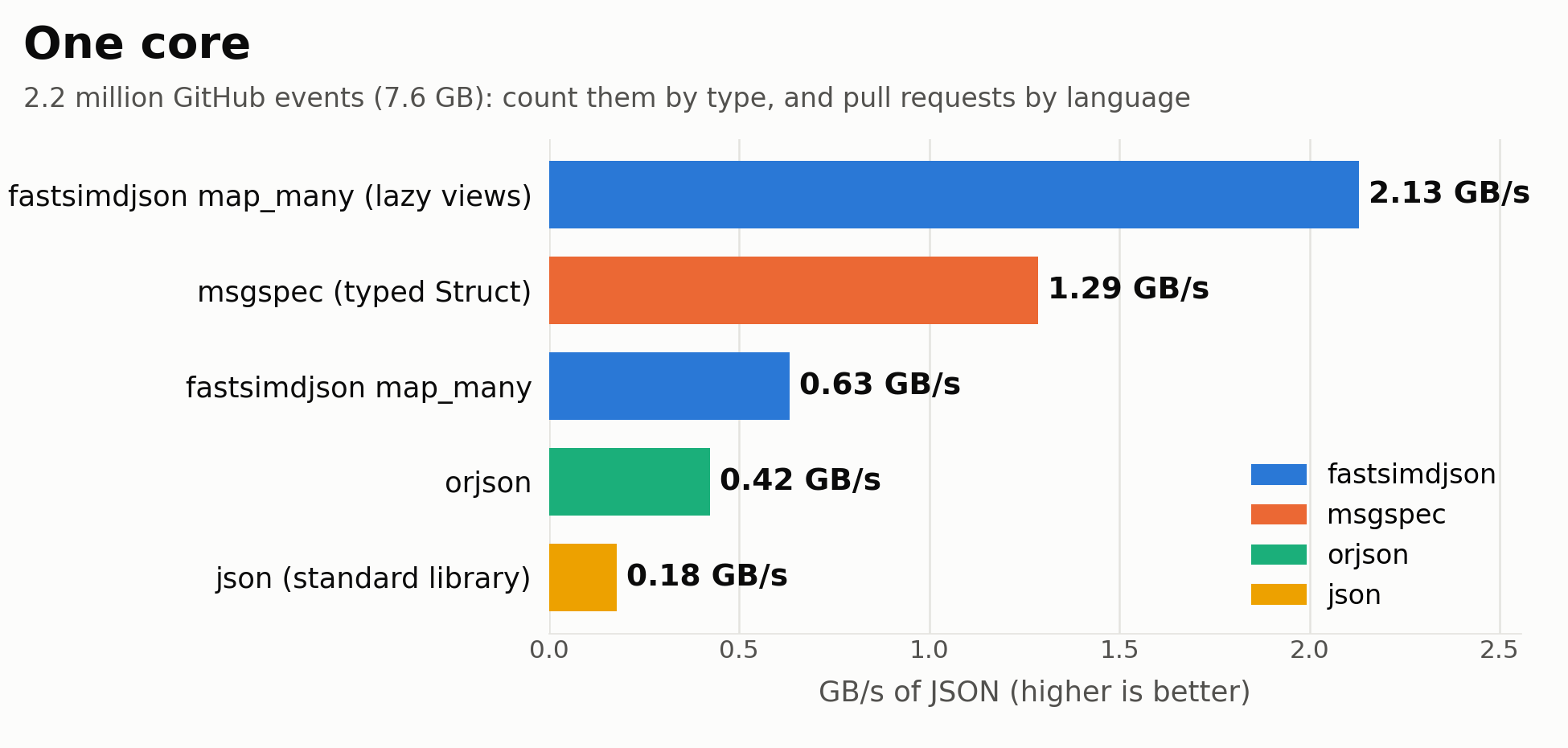
I use a server with two Intel Xeon Gold 6548N processors (64 cores), Python 3.14.6, and the current versions of the libraries (fastsimdjson 0.6.0, orjson 3.13.0, msgspec 0.22.0). The data is decompressed in memory before the timer starts. I report the best of seven runs, and one run for the slow methods: the single-thread parsers, and the standard library on 64 threads. Let us first use a single core.
method
GB/s
json (standard library)
0.18
orjson
0.42
fastsimdjson map_many
0.63
msgspec (typed structures)
1.29
fastsimdjson map_many (lazy)
2.13
The standard library needs 42 seconds to go through the eight hours. With fastsimdjson and lazy views, it takes 3.6 seconds. Notice how the methods that materialize everything (json, orjson and fastsimdjson without lazy views) are slow: most of the time goes into creating Python objects that we discard right away.
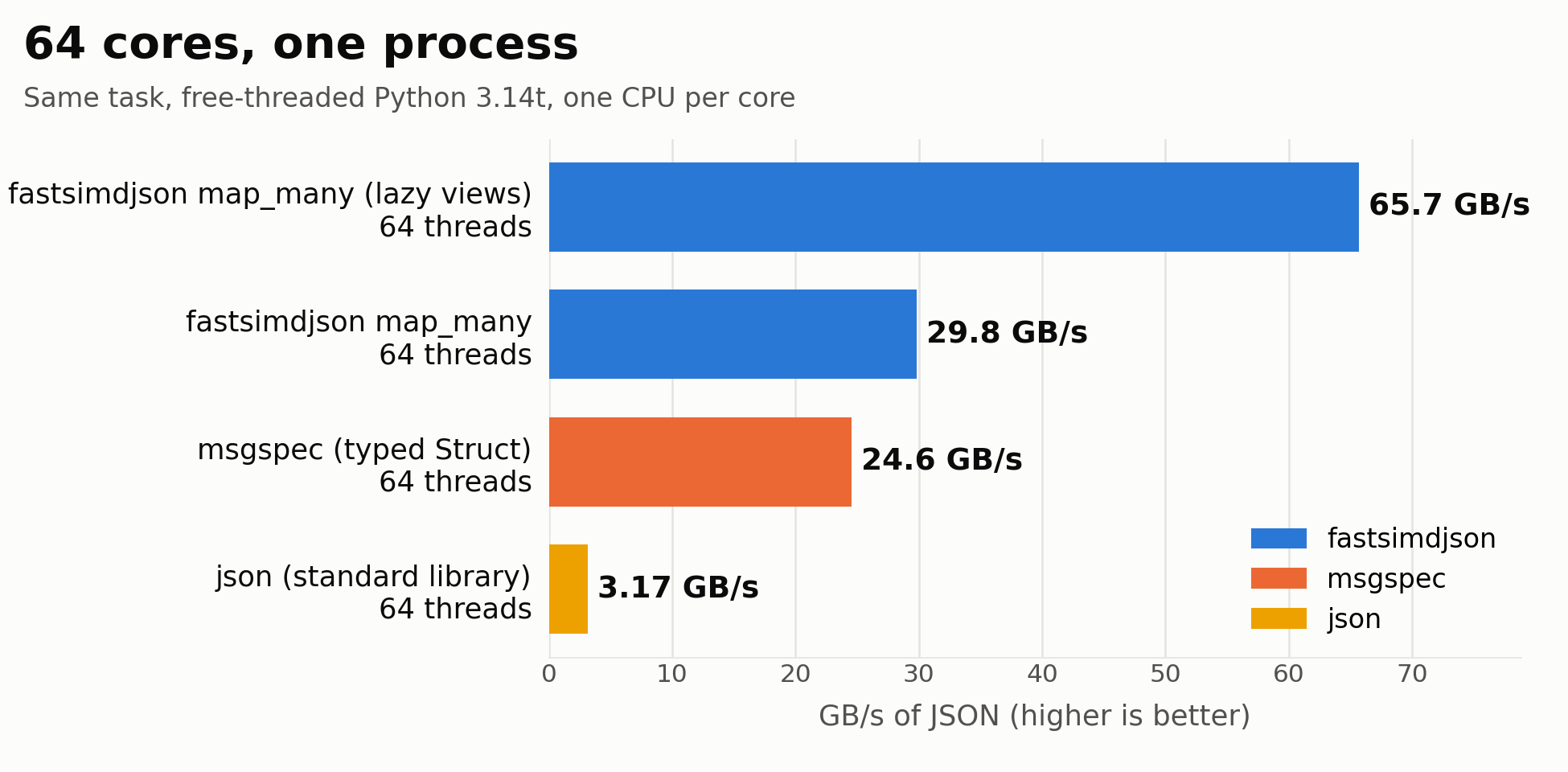
Now let us use all 64 cores, still in one process. On free-threaded Python, I use a thread pool for json and msgspec, and map_many(..., threads=64) for fastsimdjson. The threads share the input.
method
GB/s
json (standard library), 64 threads
3.17
msgspec (typed structures), 64 threads
24.6
fastsimdjson map_many, 64 threads
29.8
fastsimdjson map_many (lazy), 64 threads
65.7
We go through 7.6 GB of JSON in about 0.12 seconds, at 66 GB/s, in one Python process. That is 31 times faster than with one core. It is faster than msgspec using 64 threads (25 GB/s).
So, can you parse JSON at tens of gigabytes per second in Python? Yes.