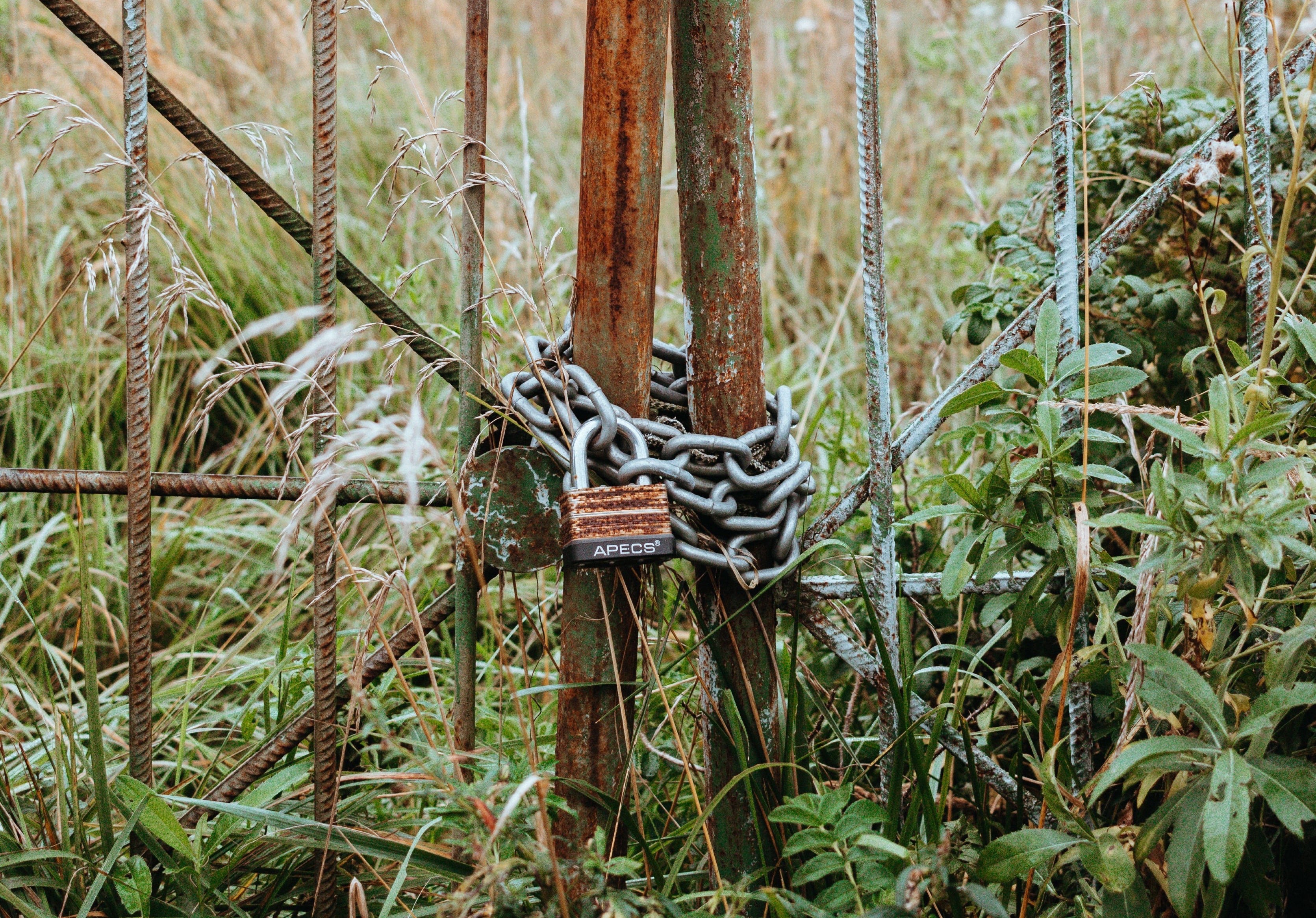
Photo by Kris Møklebust
The weather in Texas has finally turned somewhat cool. There’s a beautiful campground an hour and a half away I’ve been excited to take my kids to. It’s private land, but for $12 you can camp there. It’s a family operation, with a hand-drawn map on the website. It is one of the few places to camp within 100 miles.
Today I pulled up the website to book it and saw this:
It is with great sadness we made the decision to discontinue individual camping and day use activities on our trails starting October 2026.
I talked to the owner. She told me how upset she was to have to do it but insurance costs keep going up, and she can’t afford to pay them. She knows what a loss this is. She gets emotional when she talks about having to do it.
Are you fucking kidding me? She can’t let people walk on her land and sleep on her dirt because of the fucking insurance costs?! The impotent fury almost choked me. Operating it as a park has kept it free from development. What will happen to it now?
The bad news about the world my children will inherit is almost unrelenting, but there are still these little pockets of joy, of undeveloped land where you can still see wildlife and not hear the constant growl, the flash and smoke of The Machine. And now there’s one less.
OK, so I tried something else. I pulled up the booking system for the state park near the closed campground. I don’t remember my parents ever having to book a goddamn campsite but now it’s a necessity. And sure enough, every campsite, every goddamned one, was booked out for months. I couldn’t find a free weekend until after Christmas.
This is the invisible hand of the market at work. This is the invisible hand giving me the middle finger.
Subscribe to my work
Over 95% of the land in Texas is privately owned. In my area in particular there is very little conservation land open to the public.
What does exist is hit hard. Takes the lakes, for example. Most lakes in Texas are dammed rivers and they are narrow. That doesn’t stop the jetskis and wakesurfing boats and wallowing wide-bottomed pontoons from squeezing into them. There is nowhere for their hulking, gleaming motors (which could outflank an Atlantic hurricane) to take them but up and down, up and down, while their speakers blast Journey’s Don’t Stop Believin’.
Like fat men roller skating down a hallway, all in a line, they follow one behind the other, never not believin, sending four foot waves over the people in the designated swimming areas. You’d think the swimmers would shake their fists at the boats, but most of them are temporarily embarrassed boat owners themselves, and they lift their beer cans in a salute to their own dream. Multimillion-dollar mansions gape down from the cliffs, emitting a steady stream of BBQ smoke and Hotel California. Ranks of lifted pickup trucks gleam in the parking lots, trucks with pristine beds that will never haul lumber, with massive knobbly tires that will never go off-road.
Behind my house growing up were hundreds of acres of open ranch land. I used to run around (probably trespassing) back there as a kid, before it was sold and turned into three separate housing developments. What remained was a tiny patch of 25 densely wooded acres in the middle around a spring. I got my first kiss there and early thrills observing animals in the wild, almost touching nose to nose with a deer and following barred owls and night herons through the trees. I thought it was city land but turned out an old lady owned it and let people walk and mountain bike through it. I took my kids exploring there until last year, when we visited and were shocked to find it almost denuded. The owner had hired crews to clear away almost all the trees and put up a fence. A neighbor I spoke to said the lady was freaked out by the fires in California and didn’t want the liability. If someone sued she’d be ruined.
And it wasn’t just any fence she built but a high fence, not to keep the deer in, but to keep them out. Why, I don’t know. But with everything built up around there, where did the deer go?
‘Meh, the deer will be fine!’ says my friend, who is afflicted with a terminal case of pathological optimism. ‘There are the same number of white-tailed deer today as there were when Columbus landed!’
Sure, and unlike in Columbus’ time, they are ravaged by CWD, an unstoppable disease that originated in a captive deer research facility in 1967, a disease that will decimate herds for decades to come and extirpate them in some areas. And since the Santa Maria landed, somewhere around 500 species in North America alone have gone extinct, and a quarter of wild mammals by biomass have disappeared.
‘Meh, quit bitching and move to a western state, one with more public land,’ says my friend. ‘Go get yours.’
My family situation makes that impossible right now, and besides, getting mine requires seven figures. He lives in a new mega housing community, and the non-protected land around him is also being colonized at warp speed by other mega homes of freakish proportions. What does everyone else do? How do they afford this life?
They don’t, of course.
As in many states, there’s a push in Idaho to transfer federal lands to state ownership, but opponents fear the inevitable pressure to sell state lands to raise money. People like the contemptible Senator Mike Lee of Utah see so much federal land as ‘underutilized’ and are pushing hard to transfer so it can be sold or leased and finally put to some actual purpose.
The Ambler Road Project in Alaska will cut a 211-mile industrial corridor through pristine wilderness to unlock the precious metals that four proposed mines will bring, disrupting caribou and salmon and destroying one of the last truly wild places in the country. Sounds like a great deal. I guess that’s why the president had the U.S. government take a 10% stake in the foreign mining company with rights to its development.
There’s only one place this leads. Wild lands have to win every single fight for eternity. Once they’re gone, they’re gone forever. Developers only have to win once. Like the old field of wildflowers at the end of my street that is now a new, shining, empty credit union: it’s never going back. And it’s not just a public-private land thing. How much are our ecosystems dependent upon private but as yet ‘underutilized’ land? I’m guessing it is a lot.
AI is supposed to improve our lives, and the boosters say it will accelerate progress. It seems like it’s just going to accelerate destruction of all but the most strictly controlled places: more mining, more extraction, more planned obsolescence, more trash, more squeezing of every resource.
The growth engine ensures this will never stop. Jevons paradox ensures that any advances and efficiencies will get plowed into the next expansion. Cost disease ensures everything gets more expensive. The protected spaces will last only as long as whatever shaky political system happens to find them quaint and worth protecting for the moment.
What’s worse is that the longer people spend away from nature, in front of screens, in cities and with no wild access, the more they forget that alternatives to their way of life even exist, or that they ever did. It’s a self-fulfilling cycle, because as the machine churns on, the alternatives really do disappear.
All you pasty, soft, terminally online wireheads need to get the fuck outside and walk to the store, and talk to you neighbors and get lost and touch grass. But that’s harder to make happen when the grass is farther and farther away and there’s less and less of it.
Look at the Starlink website. Gorgeous marketing shots of people in stunning locations…on their goddamn phones.
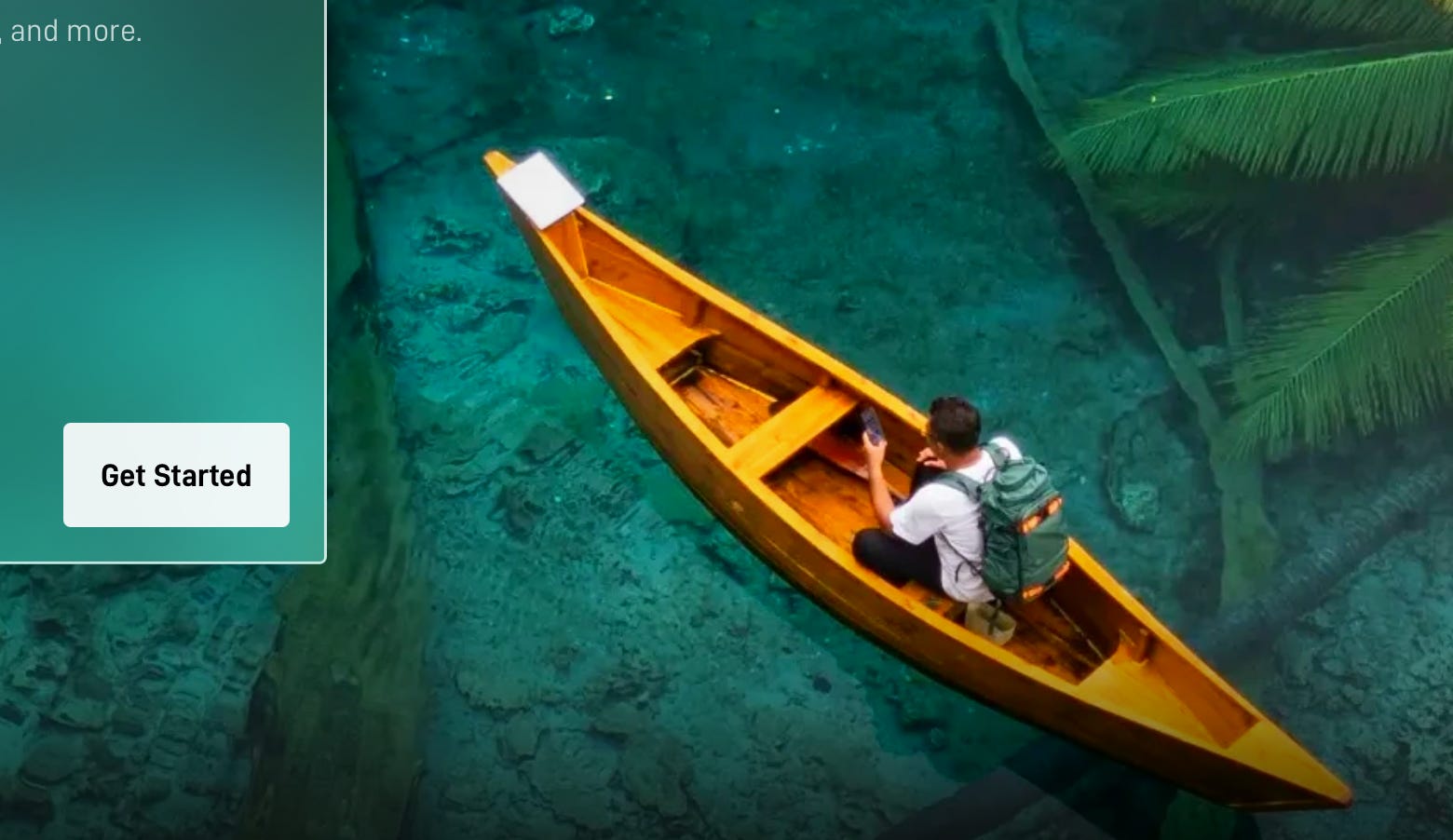
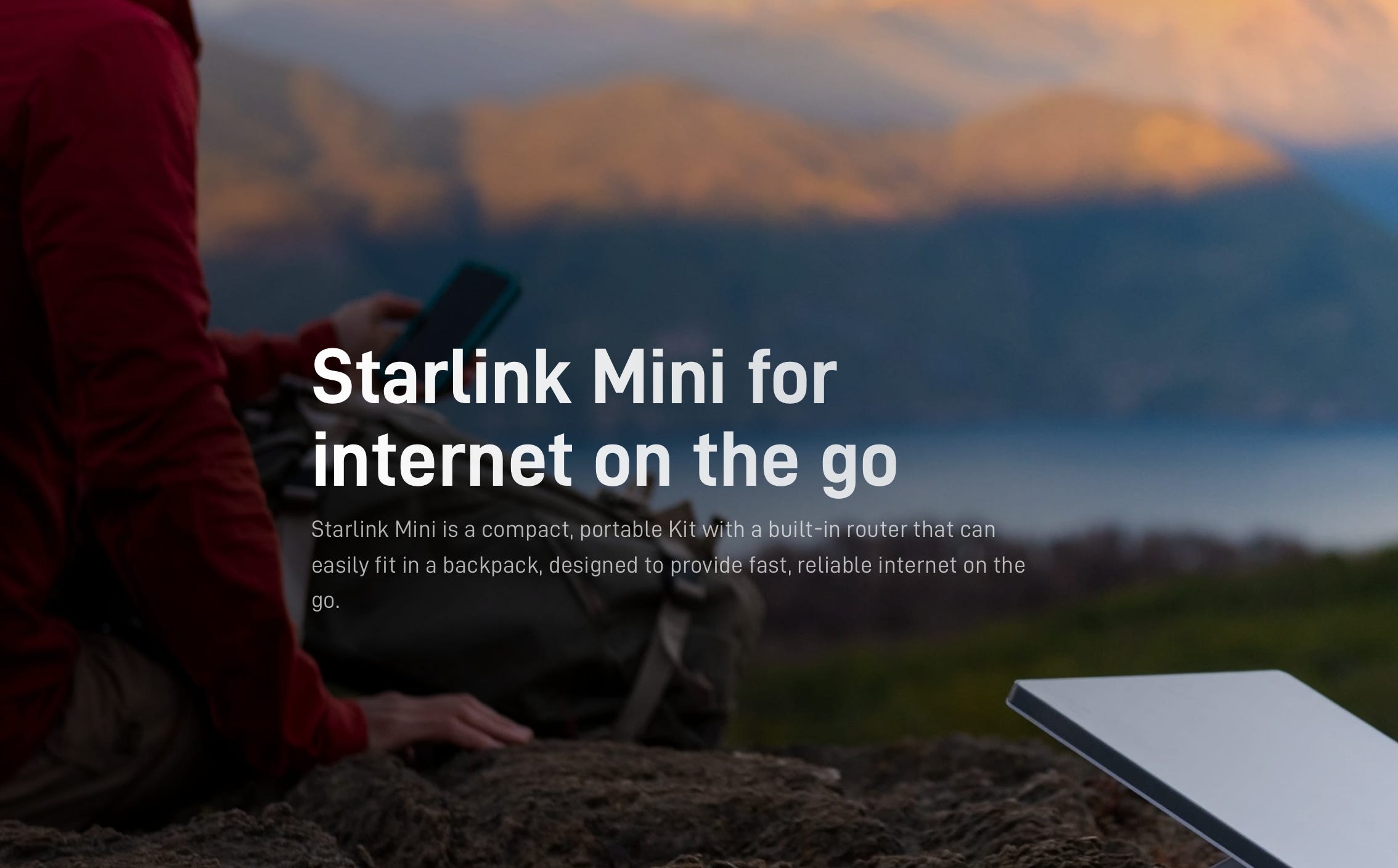
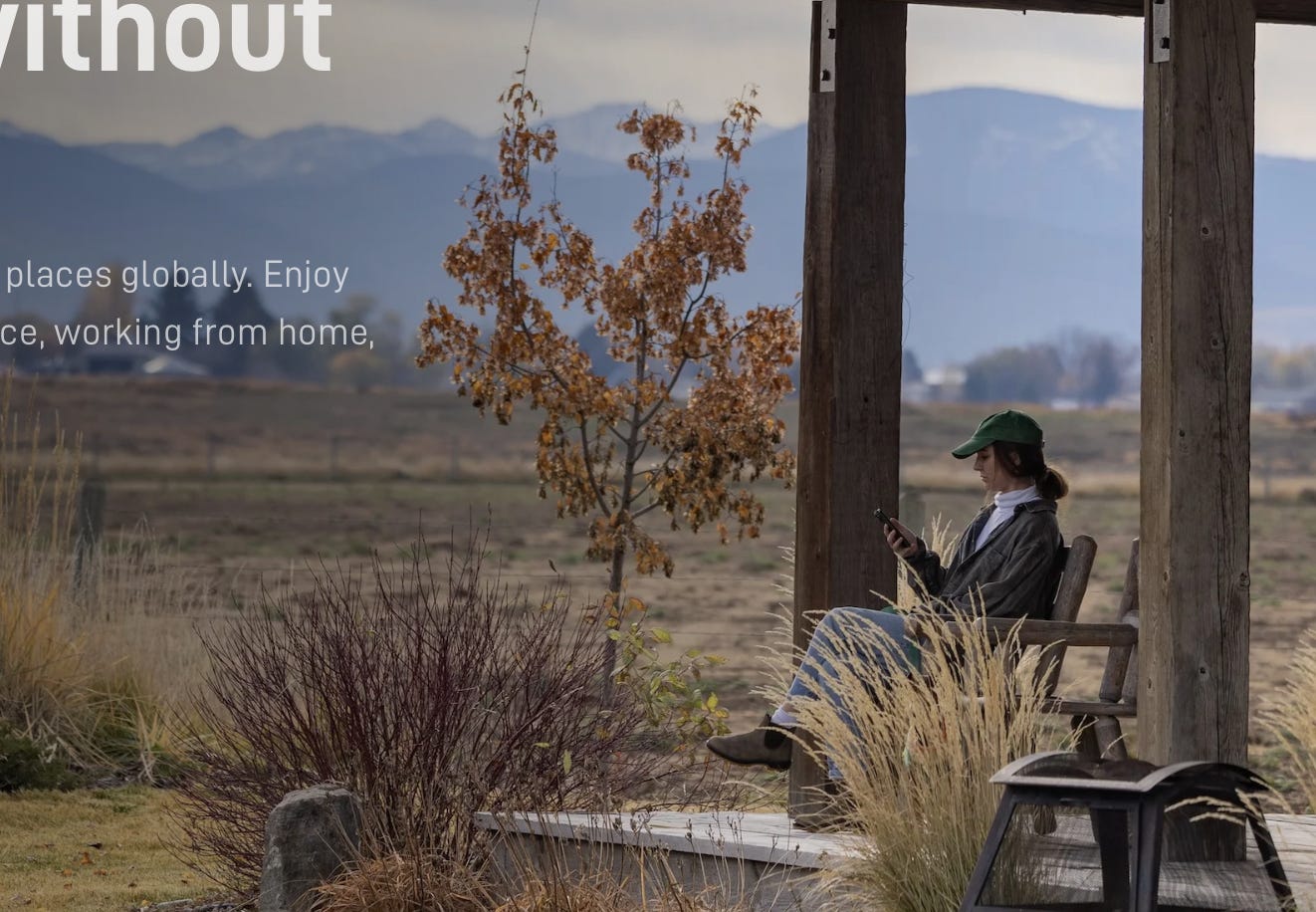
Are you fucking kidding me!? Makes my stomach churn.
And yet I am not surprised at this travesty, this mirror. Just sad and tired of having the constant reminder of where we are going and how quickly we’re getting there1.
At an individual level, we’ll go on coping, building our lives one locally-optimized nail at time until our common puddles are choked with shining boats, our lungs are filled with patented chemicals, our grasslands are parking lots, and our nerves are frazzled from the constant manipulation enabled by our own worst impulses.
It’s not that bad, they say. Bullshit, I say. It is that fucking bad and it’s getting fucking worse. Looking around, I see no story about the future, no working vision, that is actually appealing. The political right and left have joined in the unquestioned worship of a progress which must never stop.
Where exactly are we going? In the introduction of Abundance, the authors lay out what is supposed to be a positive vision for the future. But it’s mostly a materialistic dystopia of comfortable consumerism with no meaning beyond excess and worldly possession. It comes across more as a prelude to Wall-E than something I actually want to experience.
The best we can hope for apparently is some sort of misty progress-enabled heaven that you just have to believe in as someone else sacrifices everything you cherish to get there. At some point we’ll magically have enough and then everything will somehow be fine, pinky promise.
The ‘environment’ doesn’t exist. It is an out-of-focus term we gesture towards because the webs of interconnecting cause and effect are so hopelessly complex that it’s about all we can say. But the real environment is the actual place you live. It is your watershed. It is the animals — the individual creatures — that live in your backyard. It is the nutrients in the soil that grows your food. It is the trees and plants outside your window right now. It is the field of wildflowers at the end of your block.
I’m no better than anyone else. I work for a tech company enabling ‘The Future’ and I sinfully enjoy having enough to eat every day. I’m just lashing out in my grief and impotence. It doesn’t have to be like this. The future seems monstrous no matter how I slice it. I have no solutions.
But still, I will teach my children to hunt and fish and see their world. I will take them camping when I can. I will keep donating to conservation and writing and talking about it, in the quixotic hope that there will be anything left to save once we finally grow up as a species.
But perhaps, as the tecnho-millenarian priests declaim from their pulpits, we may just get lucky enough to sleepwalk over the yawning chasm and come out the other side to a sparkling wonder-verse of terraformed galaxies and unlimited riches.
But not today. Today it is too expensive to keep a campground open.
Good news, the more people that get Starlink, the closer we get to our goal of 100,000 satellites swarming through our one-and-only night sky.